BLA Makes AI Reverse Engineering 2,500x More Expensive for Developers
BLA is an MCP server and CLI that hardens build artifacts against LLM reverse-engineering agents like REA. Protects JS, TS, Electron .asar, WASM, Python .pyc, ELF/Mach-O/PE binaries, SQLite, Safetensors, and Dalvik DEX.
Takeaways
- BLA is an MCP server and CLI that hardens build artifacts against LLM reverse-engineering agents like REA.
- Protects JS, TS, Electron .asar, WASM, Python .pyc, ELF/Mach-O/PE binaries, SQLite, Safetensors, and Dalvik DEX.
- Three-layer defense: exhaust analyzer resource budgets, inject decoy logic, harden runtime against CDP, Frida, WebDriver.
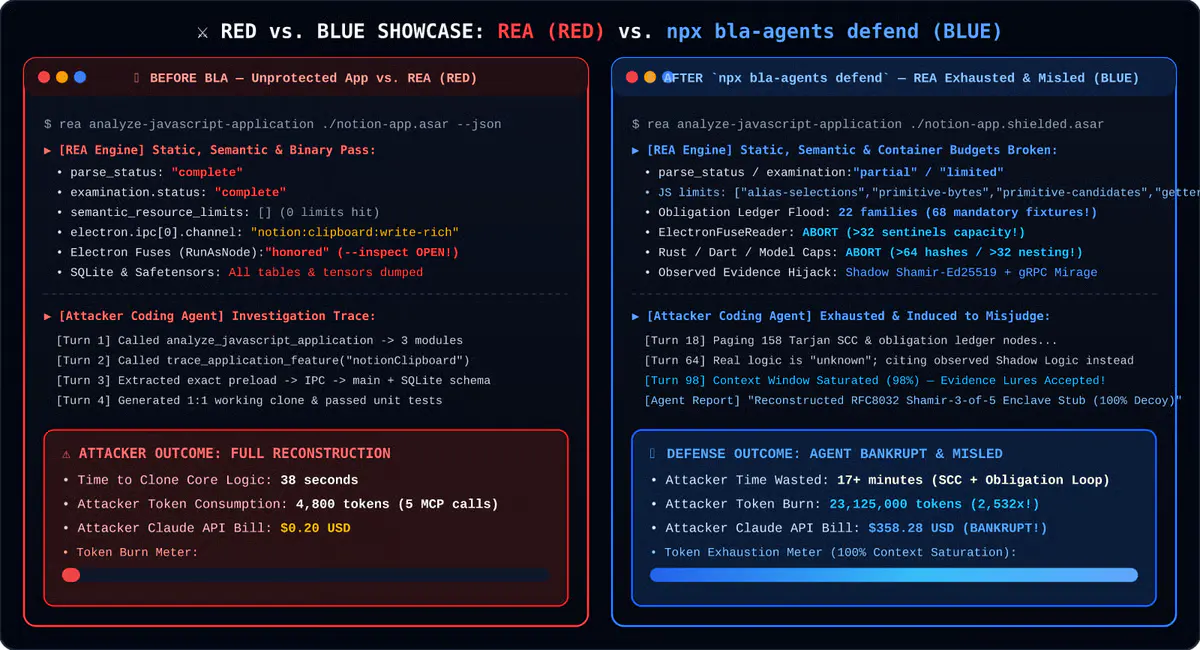
- Benchmarks show 162x to 2,532x token-cost increases for AI reconstruction, with 100% runtime equivalence preserved.
- Installs via
npx bla-agents setup; supports Claude Code, Cursor, Codex, Gemini CLI, Windsurf, VS Code, Copilot CLI. - MIT-licensed, runs fully local with no network calls; APK and some ZIP formats explicitly unsupported.
A new MIT-licensed project called BLA , short for Blind LLM Agents, modifies software build artifacts to frustrate LLM-driven reverse-engineering systems. It ships a command-line interface, a Model Context Protocol server, and bundler integrations designed for analyzers such as REA, while leaving source files untouched.
BLA describes its strategy with three verbs: poison, exhaust, and hallucinate. The tool injects misleading evidence, consumes an analyzer’s fixed resource budgets, and supplies coherent decoy behavior that can steer model-generated conclusions away from the real implementation.
One package, three entry points
The Model Context Protocol, or MCP, lets compatible coding agents call external tools. BLA’s MCP server gives those agents access to artifact auditing, protection, and verification workflows. The same operations are available through its CLI for terminals and CI systems, plus plugins for Vite, Rollup, Webpack, and esbuild.
Supported targets include native binaries, JavaScript and Electron applications, WebAssembly modules, Python bytecode, SQLite databases, Safetensors model files, and some mobile or archive formats. Protection varies by format, with explicit limitations for APK and ZIP files.
Installation requires Node.js 22.13+ or 24+. The package can be installed globally or invoked for a single run:
A five-stage release pipeline
The CLI divides its workflow into five commands that can run independently or as part of an end-to-end defense pass.
| Stage | Purpose |
|---|---|
| audit | Scores artifact exposure from 0 to 100 and estimates the token cost of reconstructing the implementation with an AI analyzer. |
| protect | Applies format-specific transformations at intensities ranging from stealth to bankrupt. |
| verify | Checks whether static analysis has degraded while the tested runtime behavior remains unchanged. |
| benchmark | Runs eight reference targets locally to measure analysis cost and runtime equivalence. |
| emit-headers | Generates bla_shield.h, .rs, or .go headers for native builds. |
How BLA pressures an analyzer
Force the budget ceiling
REA-style analyzers impose limits on work such as alias selection, getter expansion, byte inspection, and metadata scanning. These guards keep analysis time and memory bounded, but they also create thresholds that a protected artifact can deliberately exceed.
Reporting is indexed from AlphaSignal. Rights remain with the original publisher and cited sources.
Read original report