Boson AI's Higgs Audio v3 Studio Brings Voice Cloning to Windows Without Python
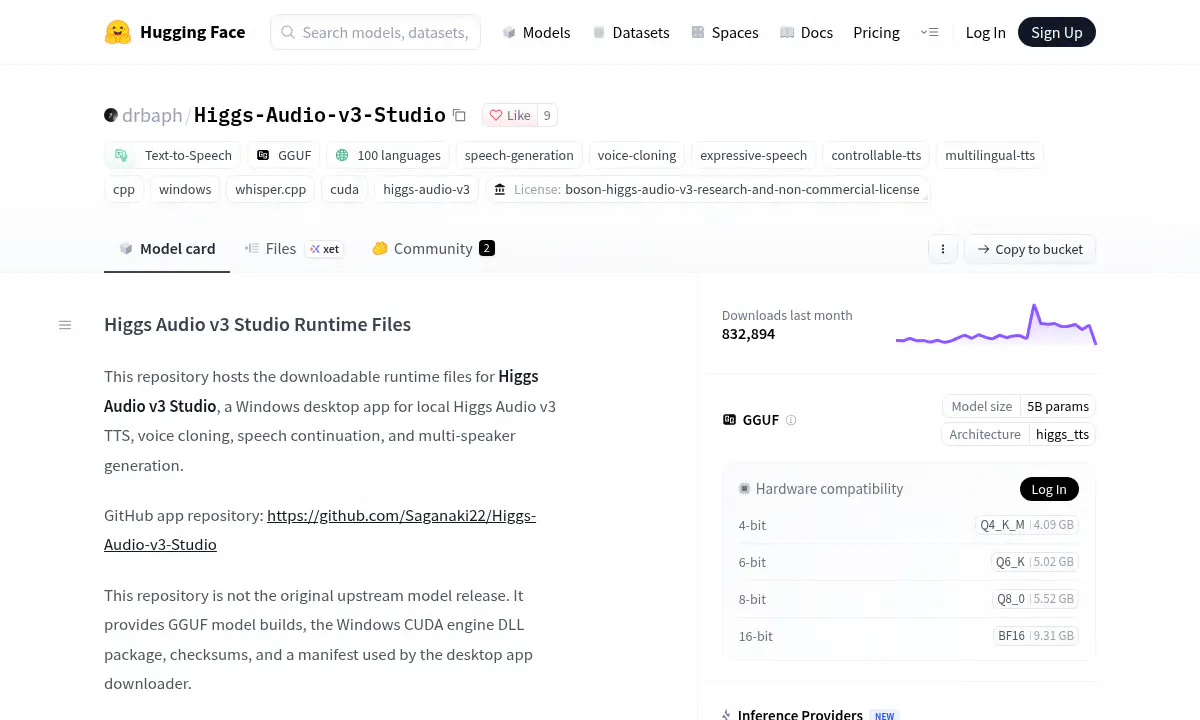
Community-built Windows desktop app runs Boson AI's Higgs Audio v3 TTS locally via GGUF and native C++/CUDA. Five quant tiers from q4_k_m (8 GB VRAM) to bf16 (16 GB VRAM), with q8_0 as the recommended default.
Takeaways
- Community-built Windows desktop app runs Boson AI's Higgs Audio v3 TTS locally via GGUF and native C++/CUDA.
- Five quant tiers from q4_k_m (8 GB VRAM) to bf16 (16 GB VRAM), with q8_0 as the recommended default.
- Covers TTS, zero-shot voice cloning, speech continuation, and multi-speaker generation in one UI.
- Ships a local API server with NDJSON streaming, plus whisper.cpp for reference transcripts.
- Upstream model hits single-digit WER/CER across 100 languages with inline emotion and prosody control.
- Research and non-commercial license only, commercial deployment requires a separate agreement with Boson AI.
Boson AI’s Higgs Audio v3 TTS previously required developers to assemble a Python pipeline around a Qwen3 backbone and custom audio tokenizer. The community-built Higgs Audio v3 Studio packages the open weights as GGUF files, runs them through a native C++ and CUDA engine, and exposes the model through a Rust and Tauri desktop app for Windows. Its Hugging Face repository has recorded more than 830,000 downloads, a count that includes repeated file retrievals.
Boson designed the upstream model for conversational agents, multilingual speech generation, and zero-shot voice cloning. According to the Boson model card , it supports inline control over emotion, speaking style, prosody, and sound effects, with reported single-digit word or character error rates across 100 languages.
Higgs uses an autoregressive decoder with roughly 4 billion parameters and a Qwen3-4B backbone. Autoregressive means it generates each token from the sequence produced so far. Its tokenizer represents audio as eight parallel streams of discrete codes at 25 frames per second. A delay pattern staggers those streams for sequential prediction, while a fused embedding converts the codes into vectors that the language-model backbone can process.
A native runtime replaces the Python stack
Studio distributes the model weights in GGUF, a format commonly used by local inference engines in the ggml ecosystem. The repository also provides a Windows CUDA engine DLL, checksums, and a manifest used by the app’s downloader.
The Rust and Tauri frontend loads the ported C++ and CUDA engine through a C application binary interface. ggml and CUDA perform inference, while whisper.cpp transcribes reference clips used for voice cloning. That transcription removes the need to enter a reference transcript manually.
Reporting is indexed from AlphaSignal. Rights remain with the original publisher and cited sources.
Read original report