Open-Source SoduWork Unifies 9 Coding Agents Under One Reviewable Workflow
SoduWork is an MIT-licensed, self-hosted engine orchestrating multiple coding agent harnesses for teams. Supports 9 harnesses including Claude Code, Codex, OpenCode, Qwen Code, DeepSeek and Kimi Code via one adapter.
Takeaways
- SoduWork is an MIT-licensed, self-hosted engine orchestrating multiple coding agent harnesses for teams.
- Supports 9 harnesses including Claude Code, Codex, OpenCode, Qwen Code, DeepSeek and Kimi Code via one adapter.
- Every request carries acceptance criteria, gets a cross-model AI review, then a human sign-off.
- Successful chats become versioned plugins that teams can review, grant and revoke.
- Built on Electron, FastAPI and PostgreSQL; deploys via Docker with self-host scripts .
- Public beta; solo use runs on SQLite locally, team deployments add audit, roles and governance.
SoduWork is an open-source, self-hostable workbench for turning coding-agent runs into reviewable team requests. It sits above tools such as Claude Code, Codex, OpenCode, Qwen Code, and DeepSeek, connecting them to a shared issue tracker with acceptance criteria, independent review, human approval, and an audit trail.
The project addresses a practical gap in agent workflows: teams need a durable record of what was requested, which agent performed the work, how the result was checked, and who approved it. SoduWork’s README summarizes the design:
“A chat ends with an answer. A SoduWork request ends when the person who asked signs off.”
Each request records its criteria, execution history, review result, and final approval. Successful runs can then become reusable team plugins.
Nine Runtimes, One Work Queue
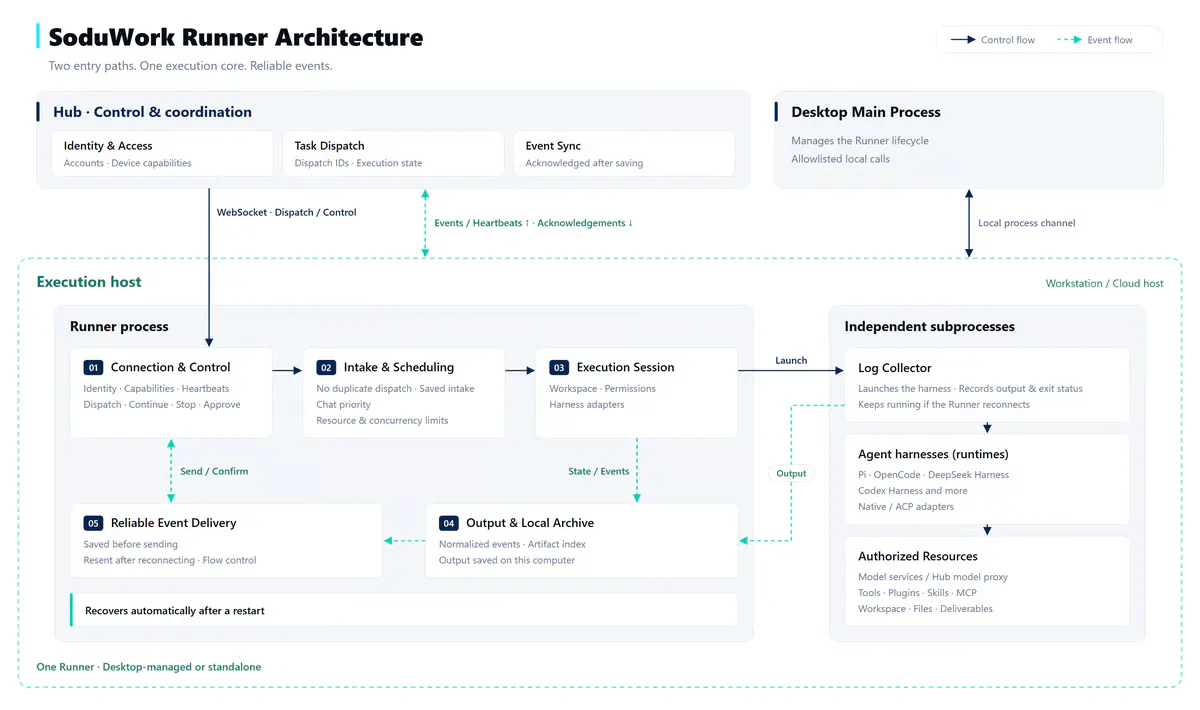
SoduWork uses harness to describe the runtime that executes an agent task. The model is the underlying large language model used by that runtime. A common adapter layer keeps requests, plugins, and reviews portable across harnesses, allowing a user to switch runtimes during a conversation without losing its history or working directory.
The catalog includes nine supported harnesses:
- Pi
- OpenCode
- DeepSeek Harness
- Qwen Code
- Kimi Code
- Codex Harness
- Codex
- Claude Code
- Google Harness
Some use native adapters, and most can be installed on demand through the Agent Client Protocol, or ACP. ACP standardizes communication between an application and an agent runtime. Compatible programs can be added to SoduWork with a catalog declaration. Claude Code and Codex authenticate through their respective vendor accounts.
Reporting is indexed from AlphaSignal. Rights remain with the original publisher and cited sources.
Read original report