Alibaba's Wan-Animate-2 Animates Characters Without Pose Maps in ComfyUI
Alibaba's Wan team released Wan-Animate-2 , an end-to-end character animation model with native ComfyUI support . No pose extraction or skeleton preprocessing: the driving video goes straight into a redesigned Diffusion Transformer.
Takeaways
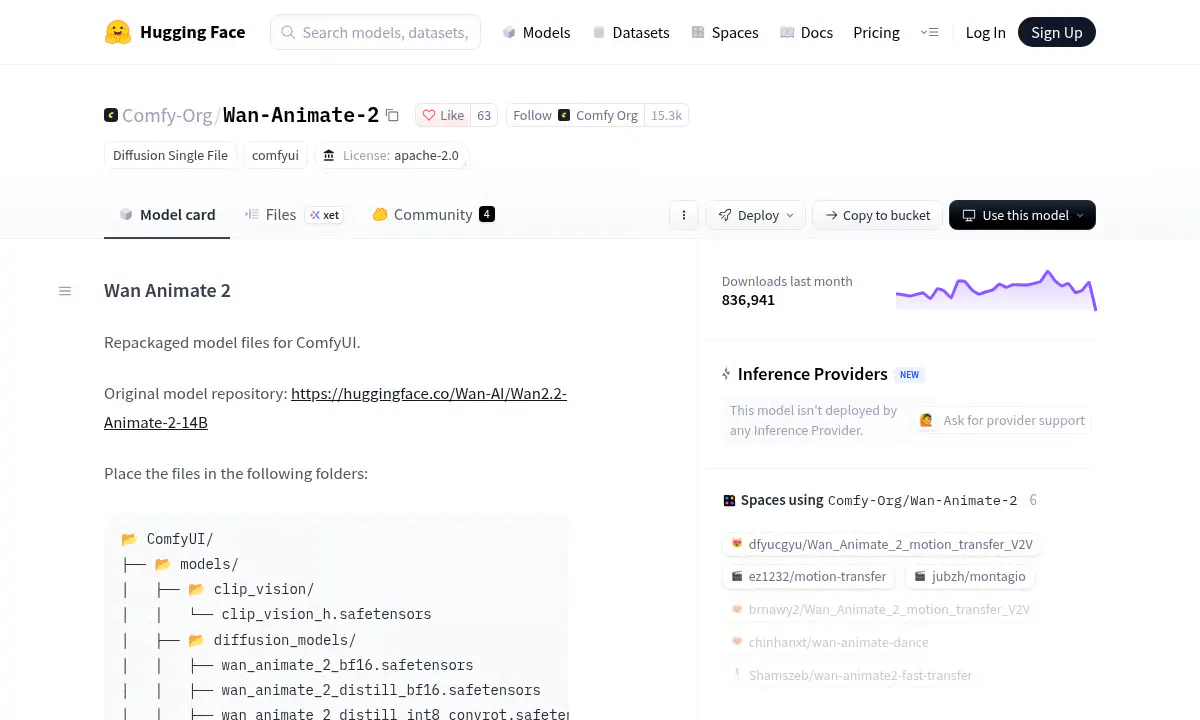
- Alibaba's Wan team released Wan-Animate-2 , an end-to-end character animation model with native ComfyUI support .
- No pose extraction or skeleton preprocessing: the driving video goes straight into a redesigned Diffusion Transformer.
- Text-driven viewpoint control decouples the output camera from the driving video's perspective.
- Dual-branch DiT with Time-Align RoPE and Sparse-Ref Attention; distilled variant runs 10 steps without CFG.
- A Lite variant targets real-time streaming for digital avatars and VTubers.
- Apache-2.0 license covering base, distilled, and INT8 weights; 836k+ downloads on Hugging Face.
Wan-Animate-2 , developed by Alibaba’s Tongyi Lab, animates a character from one reference image and a driving video. The user-facing pipeline requires no skeleton extraction, pose keypoints, or separate preprocessing stage.
Comfy-Org has added native support through new nodes and published workflows in its ComfyUI release post . Its repackaged weights had recorded more than 836,000 Hugging Face downloads at publication.
Pixels replace pose maps
Many earlier character-animation systems convert a driving video into an OpenPose skeleton or another intermediate control signal before generation. Expressions, finger positions, clothing movement, and other details can disappear during that conversion, leaving the diffusion model unable to recover them.
Wan-Animate-2 sends the reference image and driving frames into a redesigned Diffusion Transformer, or DiT, which learns appearance and motion together. A DiT applies transformer layers within the diffusion process that gradually converts noise into video. Direct conditioning gives the model access to visual cues that a pose map would omit.
Four additions expand shot control
- Text-directed viewpoints. A prompt can change the output camera angle independently of the driving video while maintaining the character’s identity.
- Generated backgrounds. The model can create a setting from the prompt instead of carrying over the source video’s background.
- Multiple characters. One performer can drive several characters, and multiple performers can control multiple characters in one generation.
- Wan-Animate-2-Lite. The team positions this variant for lower-latency digital avatars and live-streaming hosts.
Reporting is indexed from AlphaSignal. Rights remain with the original publisher and cited sources.
Read original report