Databricks AI Index Reveals Claude Opus 5.5 Grabbed 38% of Enterprise Tokens
Databricks launched the AI Index , a public tracker of enterprise model adoption, spend, and coding benchmarks. Data covers 10,000+ enterprises on Unity Gateway plus coding evaluations on Databricks' private codebase.

Takeaways
- Databricks launched the AI Index , a public tracker of enterprise model adoption, spend, and coding benchmarks.
- Data covers 10,000+ enterprises on Unity Gateway plus coding evaluations on Databricks' private codebase.
- Claude Opus 5.5 jumped from 7.2% to 37.9% of proprietary tokens in six weeks after launch.
- Single-provider enterprises fell from 64% in July to 28% by November 2.
- Open-weight token share quadrupled to 30.9%; DeepSeek V4.1 and GLM 5.3 hit 93.1% pass rates.
- Cost per task varies 32x between models with identical success rates, exposing token-price pitfalls.
Databricks has launched the Databricks AI Index , a public resource tracking enterprise model adoption, token spending, and coding-agent performance. It combines anonymized traffic from more than 10,000 companies with a private benchmark built on Databricks’ multi-million-line codebase.
Model releases outrun static rankings
Since May 2026, a flagship proprietary or open-weight model has arrived about once a week. Including regional labs reduces the average interval to 3.7 days. Databricks plans to update the index weekly so developers can compare recent models using current usage and benchmark data.
Real traffic meets private code
The index draws from three related measurements:
- Adoption: Aggregated, anonymized traffic from more than 10,000 Unity Gateway customers, including digital-native companies and Fortune 500 and Global 2000 enterprises. The data covers requests routed to external providers such as Anthropic and OpenAI.
- Spending: Estimated costs based on token consumption and providers’ public prices.
- Coding quality: Agent performance on Databricks’ private codebase. Hidden tests determine whether generated code works, without using another model to grade the answer.
Public prices can differ from negotiated enterprise rates, and results from one internal codebase may not transfer to every language or stack. The adoption figures also describe traffic routed through Databricks, making them a sample of enterprise usage rather than a market-wide census.
Teams are spreading traffic across labs
OpenAI gained token share through its 6-series Sol and Astra models. Following the launch of Claude Opus 5.5, traffic shifted toward Anthropic. The broader trend points to provider diversification as companies assign workloads across multiple model families.
| Measure | Earlier share | Later share | Period |
|---|---|---|---|
| Claude Opus 5.5 share of proprietary-model tokens | 7.2% | 37.9% | Six weeks |
| Anthropic provider share | 57.6% | 68.8% | Same six-week window |
| Enterprises using one provider | About 64% | 28% | July to November 2 |
Open weights claim nearly a third of tokens
Open-weight models publish weights that teams can deploy or customize, subject to each model’s license. Their share of enterprise token traffic rose from 7.3% in July to 30.9% in November. Three placed in the coding benchmark’s top 10, with DeepSeek V4.1 and GLM 5.3 tied for third at a 93.1% task pass rate.
Task cost exposes cheap-token traps
The benchmark estimates cost per task from public prices and the tokens consumed across an agent’s turns. Each turn represents another model-agent exchange, so repeated attempts can make a low-priced model expensive at the task level.
| Model | Task success | Average cost per task | Average turns |
|---|---|---|---|
| GPT-6 Luna | 89.1% | $0.05 | Not reported |
| Claude Opus 5.5 | 89.1% | $1.62 | Not reported |
| Gemini 3.8 Flash | Not reported | $11.97 | 140 |
| Claude Fable 5.1 | 96.0% | $7.47 | Not reported |
| Muse Wonder | 94.9% | $1.53 | Not reported |
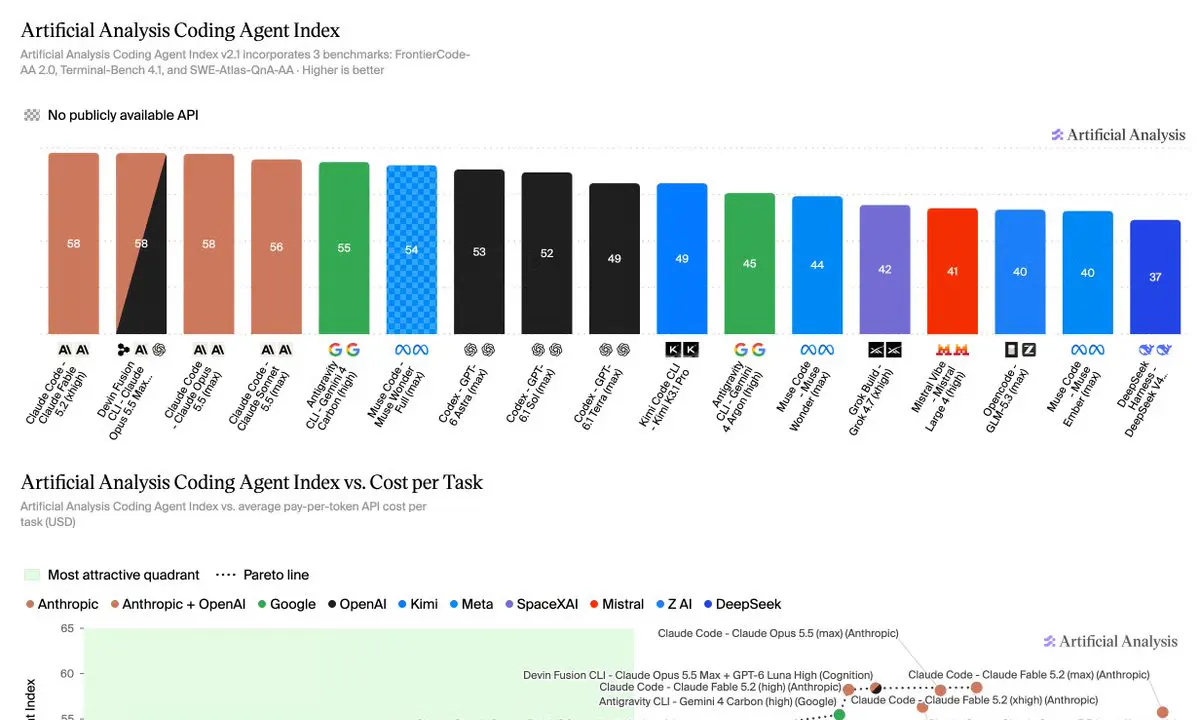
GPT-6 Luna matched Claude Opus 5.5’s success rate while costing about 32 times less per task. Gemini 3.8 Flash showed how iteration compounds cost: its low token price was offset by an average of 140 turns, making it one of the benchmark’s most expensive models.
Claude Fable 5.1 led on task success, while Muse Wonder finished 1.1 percentage points behind at roughly one-fifth of the cost. Fable 5.1’s share of proprietary-model tokens fell from 5.5% to 0.6% during the six weeks after launch.
A few users dominate the bill
Enterprise AI spending in the sample was heavily concentrated. The median user spent $2.49, while the 99th-percentile user spent $699.74, about 281 times more. Databricks attributes most high-end usage to developers running coding agents, which gives platform teams a concrete reason to set per-user budgets, alerts, and workload-level limits.
The index also markets the gateway
The index showcases Unity Gateway , Databricks’ routing and governance layer, and Smart Routing , which can select a lower-cost model when a task does not require a flagship system. Databricks benefits when enterprises adopt multi-model routing through its platform.
Unity Gateway’s position also gives Databricks access to usage data that public leaderboards generally lack. Developers evaluating the index should account for its Databricks-centered sample and validate the published rankings against representative tasks from their own codebases.
Use task-level data, then verify locally
- Measure complete tasks: Compare success rate, total cost, latency, and agent turns instead of relying on token prices alone.
- Test representative code: Run candidate models against the languages, repositories, tools, and failure modes found in production.
- Preserve provider portability: Use routing and fallback policies that allow workloads to move as model quality and prices change.
- Control concentrated spending: Apply budgets and alerts by user, project, model, and environment.
Reporting is indexed from AlphaSignal. Rights remain with the original publisher and cited sources.
Read original report