Georgia Tech's MO-Playground Trains Robots 271x Faster With Open-Source GPU Tool
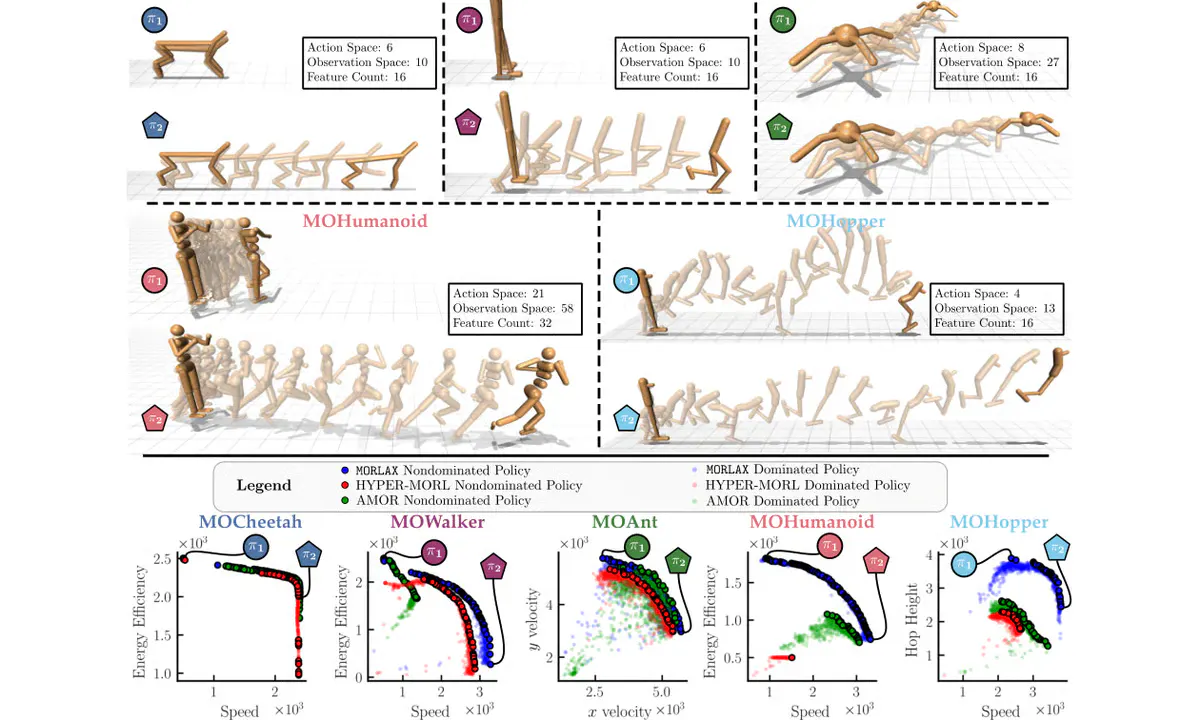
Georgia Tech and ARL release MO-Playground , a JAX-native multi-objective RL toolkit for robotics. New MORLAX algorithm uses hypernetworks mapping trade-off vectors to full policy parameters. Reports 21x to 271x speedups over HYPER-MORL across five MuJoCo benchmarks.
Takeaways
- Georgia Tech and ARL release MO-Playground , a JAX-native multi-objective RL toolkit for robotics.
- New MORLAX algorithm uses hypernetworks mapping trade-off vectors to full policy parameters.
- Reports 21x to 271x speedups over HYPER-MORL across five MuJoCo benchmarks.
- Humanoid Pareto front hypervolume improves 7.33x while training in 92 seconds versus 7 hours.
- Trains BRUCE bipedal robot across six objectives in 2h 11m versus prior 5-day baselines.
- Limitations: convex Pareto fronts only, objectives must be specified mathematically upfront.
Researchers at Georgia Tech’s Dynamic Mobility Lab and the Army Research Laboratory have released MO-Playground, an open-source, pip-installable suite for multi-objective reinforcement learning on GPU physics engines. Its MORLAX algorithm learns policy families spanning competing goals such as energy use, smoothness, velocity tracking, and arm motion. Engineers can select a trade-off after training, avoiding another training cycle when deployment priorities change.
The accompanying research paper , published in IEEE Robotics and Automation Letters, reports wall-clock speedups of 21× to 271× over HYPER-MORL, the previous state of the art. On several continuous-control benchmarks, MORLAX also produces Pareto sets with greater hypervolume, meaning they cover more useful combinations of objectives.
Scalar rewards freeze decisions early
Conventional reinforcement learning commonly collapses every goal into one scalar reward. Engineers assign coefficients to terms such as speed, stability, smoothness, and power consumption, fixing their relative priorities before training. Changing those coefficients later usually requires a new run.
Multi-objective reinforcement learning keeps the reward as a vector with one component per objective. Training seeks a Pareto set: policies for which improving one objective would degrade at least one other. That set allows a system designer or operator to choose among supported trade-offs after training.
Many existing MORL implementations rely on CPU simulation and require hours or days to approximate a useful Pareto set. MORLAX combines JAX vectorization with MuJoCo MJX, allowing thousands of physics environments and multiple policy configurations to run concurrently on a GPU.
Reporting is indexed from AlphaSignal. Rights remain with the original publisher and cited sources.
Read original report