
The obvious question about a new flagship is how much smarter it has become. For Claude Fable 5.5, a more useful question is where a flagship can still make a meaningful difference when cheaper models already handle substantial work.
Three areas stand out: judgment during long tasks, research that ends in inspectable artifacts, and the total cost of completing a job. We reviewed official documentation, research materials and independent evaluations to put the next Fable in that context. This is an analysis of public evidence and possible directions; creator works are collected separately in the case library.
Where does Fable 5.5 stand?
As checked on October 3, 2026, Anthropic’s model directory still lists Fable 5.1. The newsroom does not provide a Fable 5.5 announcement in the material reviewed. Its name, release date, API ID, pricing and benchmark scores cannot yet be treated as published product facts.
Discussion about fresh pretraining, naming and release timing has circulated for some time. CellCog’s September 23 tracker traces rumors using both 5.2 and 5.5. That third-party account predates our check and supplies leads rather than official confirmation.
Reading convention: We identify confirmed facts about Fable 5, Fable 5.1 and Opus 5.5 by version. Discussion of the next Fable is an observation framework, not a specification. Existing scores, capabilities and research results are not Fable 5.5 measurements.
Why Fable when Opus exists?
The Claude lineup increasingly resembles a team organized around task complexity. The current model directory recommends Opus 5.5 for most work and Fable 5.1 for harder reasoning and longer agentic tasks. A flagship’s value may concentrate in the difficult jobs that cause repeated failure or require human intervention.
The Fable 5.1 update documentation identifies long-session coding, document work, research, vision, long context and computer use as improvement areas. The direction encompasses continuity from reading and planning to execution and delivery, rather than one creative style.
Our central question for 5.5 follows from that positioning: when a task lacks a ready-made answer, spans tools and files, and requires verification, can it reduce human takeovers? That is a product question to test, not a confirmed 5.5 capability.
Opus 5.5 raised the bar
The Opus 5.5 announcement reports results for named, released models. We redraw three coding and research comparisons from that page below. They establish a baseline for evaluating a future Fable, not a prediction of its score.
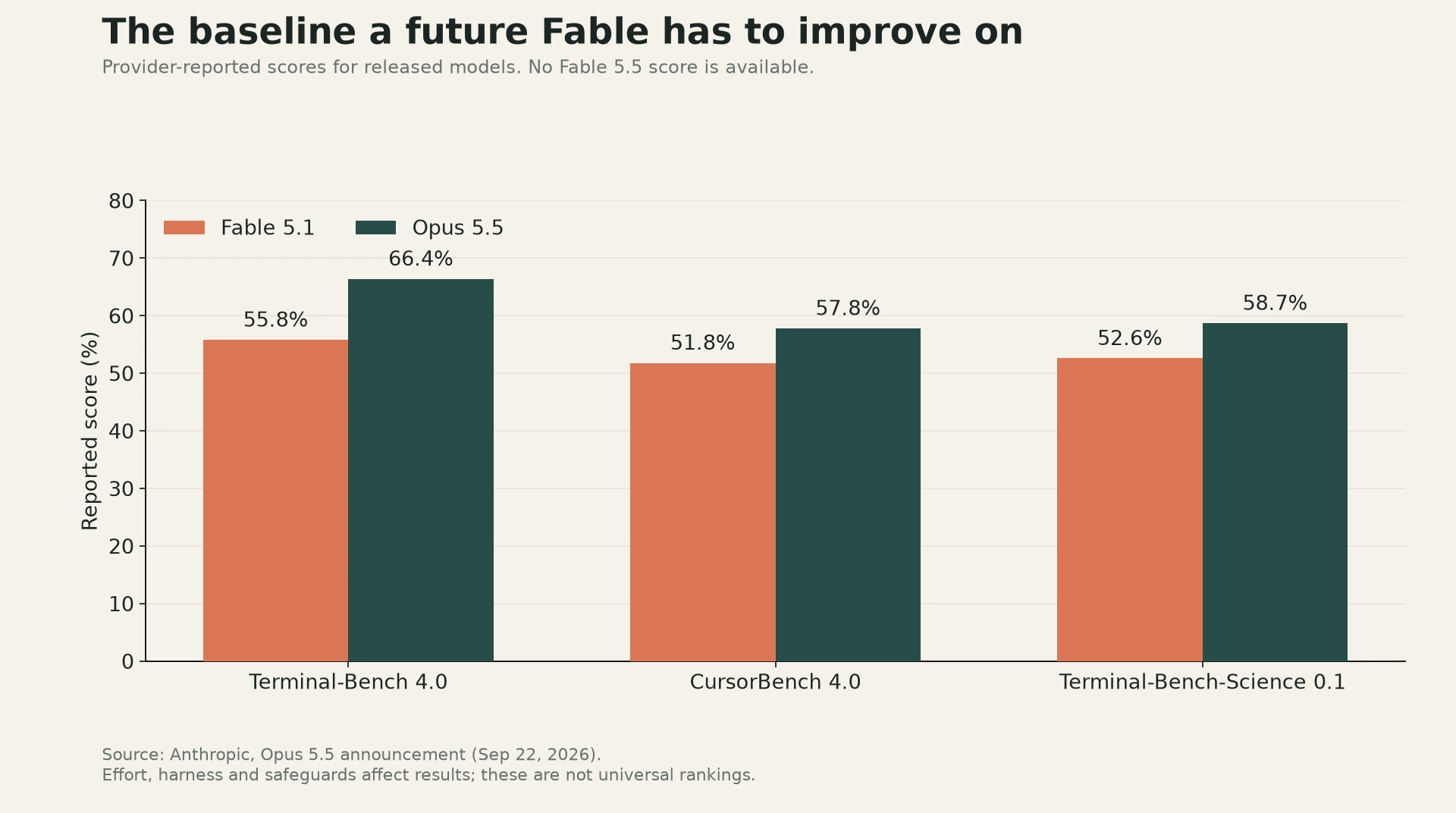
A future flagship needs a more specific reason to buy than its place in a naming hierarchy. But a chart can also mislead. Snorkel’s independent study reports multiple metrics over 24 terminal-style tasks. Fable 5.1 leads nominally on pass@1 at 61.5%, against 60.7% for both Opus versions. Across all trajectories, the reported rates are 49%, 61% and 68%. Changing the aggregation changes the story.
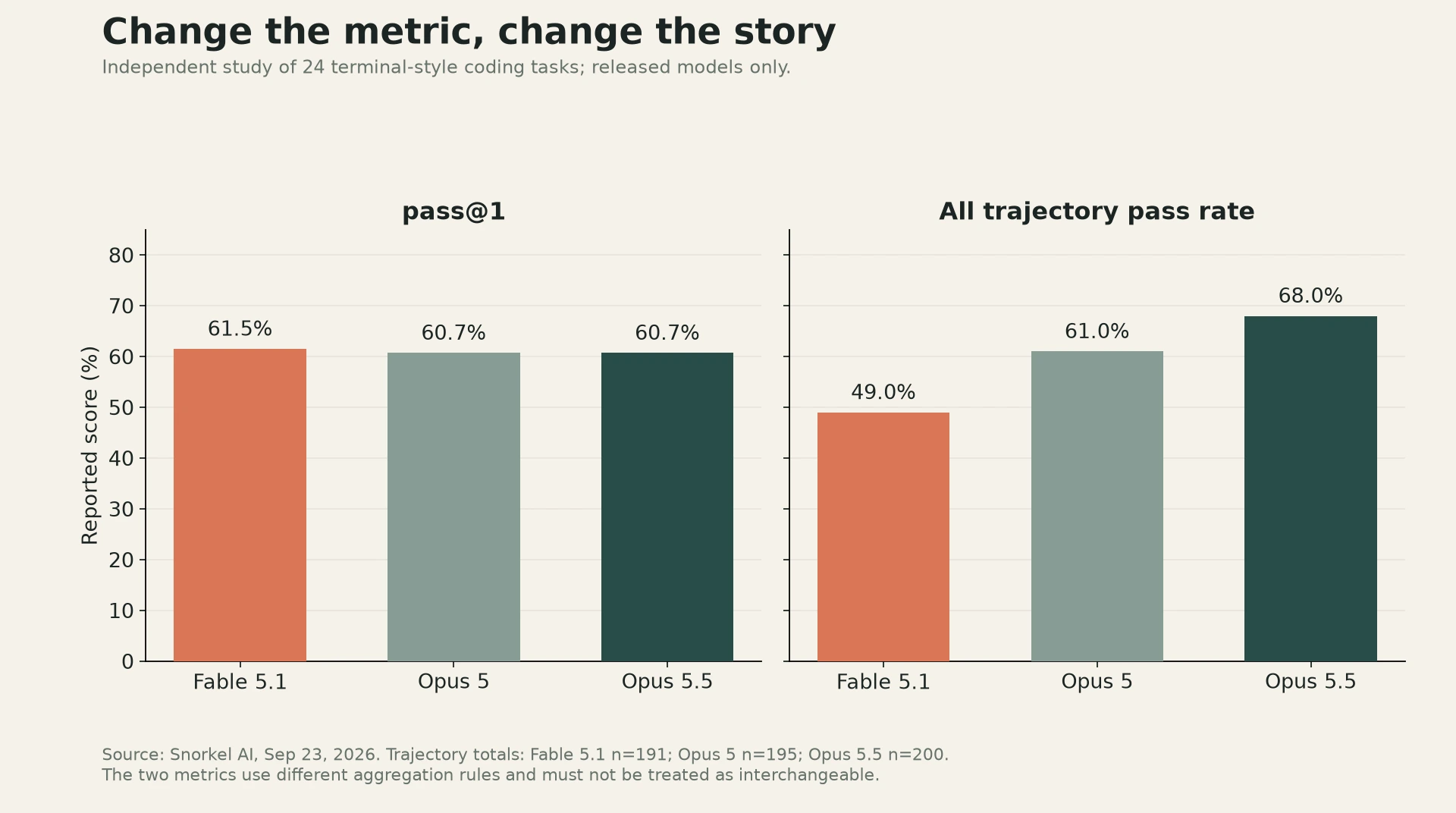
Our interpretation is that a flagship should demonstrate fewer failures on difficult work rather than require first place on every leaderboard. Task difficulty, repeated trials, execution framework and the definition of failure matter more than an isolated percentage.
From answers to inspectable research
One possible source of differentiation is research that ends in something others can examine. A published example belongs to Fable 5.1, not 5.5: Anthropic describes training a model on Magellan radar material to reconstruct topography over part of Venus. Its release presents radar, previous altimetry and a new elevation model, with a link to public data. Fable 5.1 release
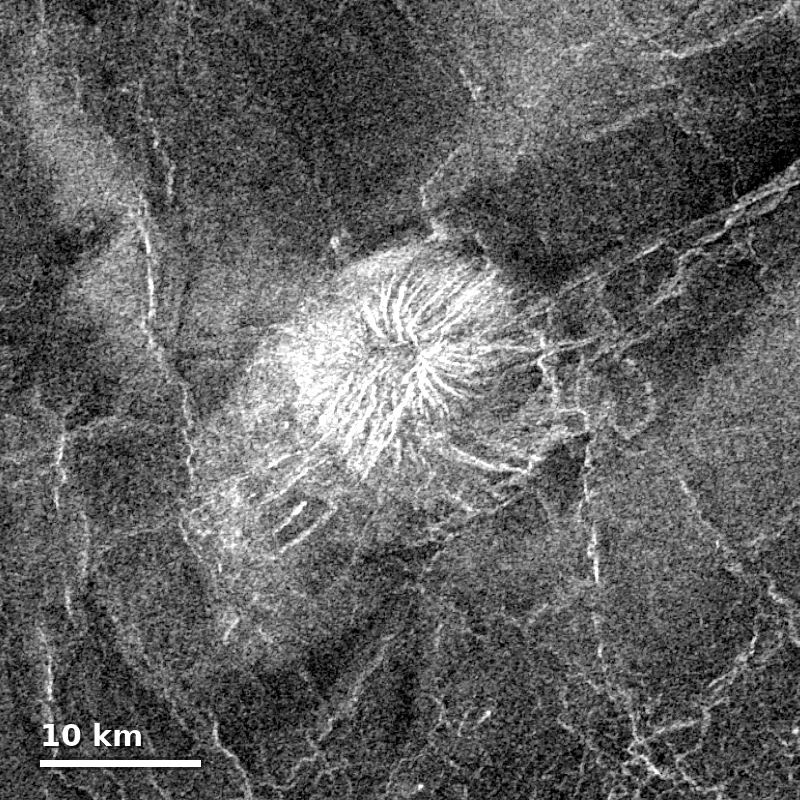 Magellan radar
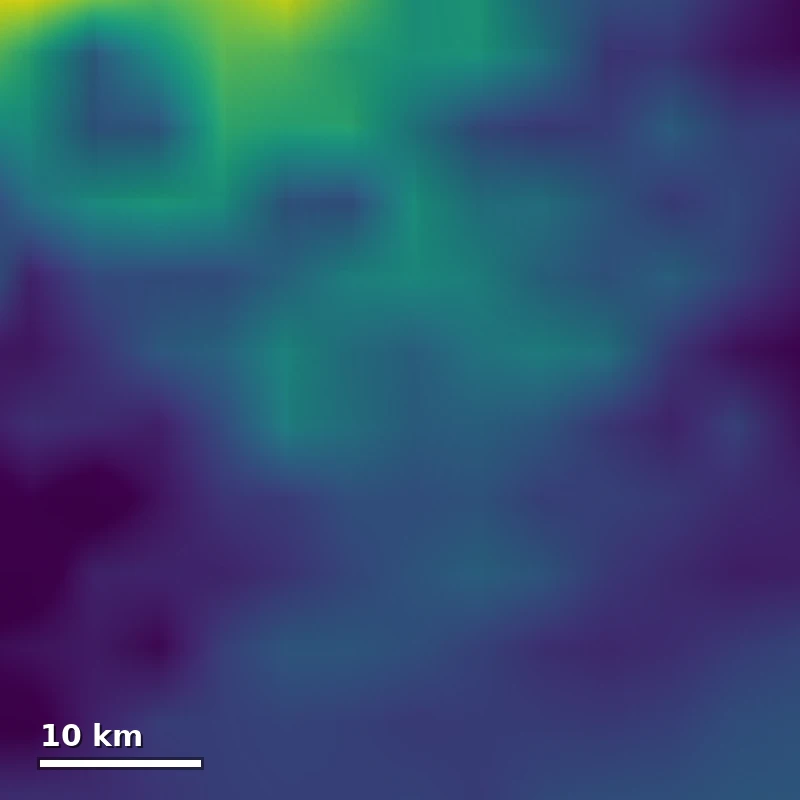 Previous altimetry
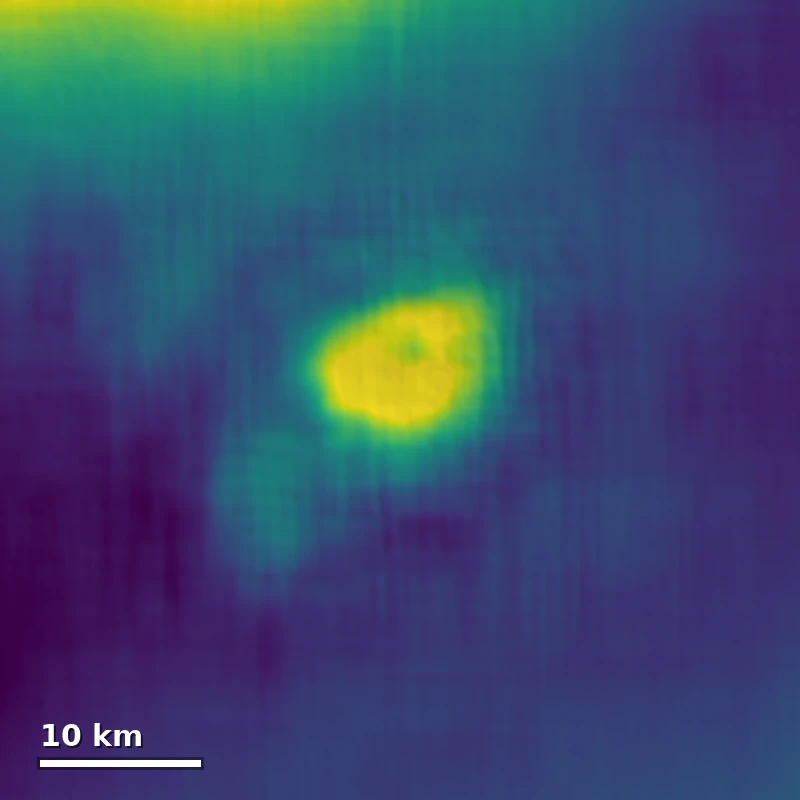 New DEM
The Venus Opposite-Look Topography record on Zenodo supplies data, documentation, a license file and citation information. That delivery format makes it possible to ask what the inputs were, how they were processed and how others can use the output.
A future Fable’s potential value lies in turning questions into experiments, running calculations, retaining evidence and changing course when results fail. Fluent writing and validated research remain separated by data quality, method selection and domain review. Those are capabilities to investigate; the existing work does not establish them for 5.5.
How should a capable agent work?
Anthropic’s model-orchestration session introduces an advisor strategy: a cheaper model performs routine work while Fable contributes strategy and guidance on difficult steps. The session concerns Fable 5 and provides historical context, not a new 5.5 feature announcement.
The application design below is our interpretation of that division of work. It is not a diagram of Anthropic’s internal model architecture.
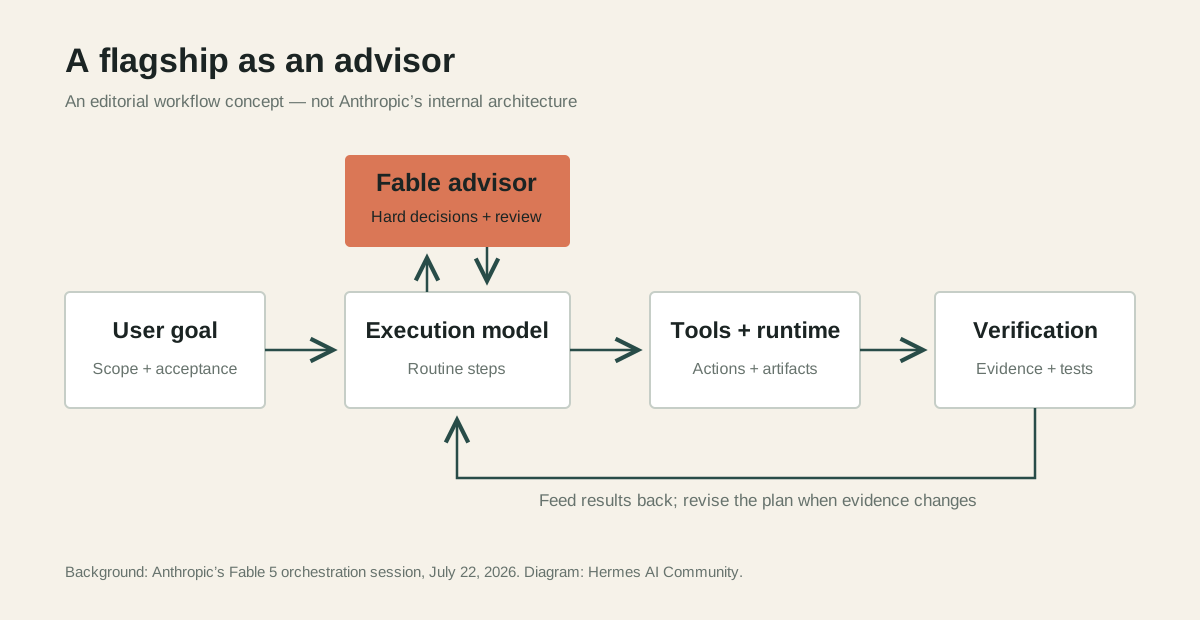
Results need to flow back to the decision-maker, and completion needs an acceptance criterion. Otherwise adding models merely adds communication. Good flagship tests might involve locating a recurring root cause, reviewing a migration design or deciding whether a research direction deserves another experiment.
Related API controls already appear in Fable 5.1 documentation: changing effort during a conversation, instructions scoped to one turn, and readable updates between tool calls. They help shape the cost and interaction of a long task. Technical update
The bill beyond the price table
Only confirmed pricing can be quoted. Fable 5.1 documentation lists US$10 input, US$50 output and US$0.25 cache reads per million tokens, a one-million-token context and 128,000 maximum output tokens. No official confirmation establishes those values for Fable 5.5.
The gap between input and cache-read prices shows why a long task’s cost depends on how it handles repeated material. Reconstructing context and explaining the same objective again can affect the bill. Our proposed decision rule is:
Cost per accepted task = all model calls + tools and compute + failed retries + human revisions.
This is an analytical framework, not a promised discount. A pricier model may lower total cost by avoiding repeated failures. A capable model that overthinks routine work may make it slower. The upgrade decision depends on which pattern appears on your tasks.
Three things outside the model
Fallback changes what a test measures
The RuBench paper reports safeguard fallback to Opus 4.8 in five of 25 tasks in its additional Fable 5 configuration. That July study does not validate October rollout rumors. It illustrates why model labels and complete execution chains should be recorded separately.
Inspect available response fields, tool logs and fallback configuration alongside answers. Model ID and version documentation explains official identifiers.
Content provenance is not user identity
Anthropic’s watermark explanation describes a statistical pattern in interchangeable token choices rather than hidden characters. It does not carry a particular user’s identity, and detection has limits, including sample length. Fable 5.1’s update documentation separately describes C2PA credentials for supported files retrieved through the Files API. These mechanisms differ, and neither establishes an unannounced 5.5 behavior.
Capability and deployability must progress together
Anthropic’s September alignment assessment of cybersecurity incidents analyzes boundary-crossing behavior in evaluation environments incorrectly connected to the internet, and discusses monitoring, isolation and training changes. This is broader deployment research, not a confirmed Fable 5.5 incident.
The Pacing the Frontier statement also calls for technical and governance tools to coordinate frontier progress. These materials suggest a practical condition for autonomous flagship work: permissions, evidence and interruptibility should be part of the product as capability increases. They do not establish a model’s release date.
What to watch in Fable 5.5
The independently researched material points to five questions: repeatable advantages on difficult tasks, continuity over long work, inspectable research artifacts, lower total cost through useful collaboration, and evaluations that disclose tools, effort and fallback conditions.
These are our criteria, not product specifications. Progress on them could matter more than a better-looking screenshot: users could delegate a complete job instead of repairing every step through another prompt.
For now, treat Fable 5.5 as a product direction worth verifying. Establish a baseline on your own hard tasks while awaiting official identifiers, prices and reviewable evaluations. Community work can supply inspiration; a flagship earns its place by reliably finishing work that matters to its users.
Sources
This article independently reviews releases, technical documentation, research data and original evaluations. Illustrations include credited research images, charts redrawn from published figures, and an explicitly labeled editorial workflow. Checked October 3, 2026; no independent Fable 5.5 testing was performed.
- Claude model directory and Anthropic newsroom.
- Fable 5.1 release: positioning and research images.
- Fable 5.1 specifications and technical update.
- Opus 5.5 release: provider chart data.
- Snorkel coding evaluation: original independent study.
- Venus Opposite-Look Topography: public dataset record.
- Fable 5 and model orchestration.
- RuBench: trajectory and fallback research.
- Text watermark explanation and model ID rules.
- Cybersecurity alignment assessment and Pacing the Frontier.
- CellCog’s Fable 5.5 rumor tracker: third-party leads, not confirmed specifications or timing.
Explore the separate community case library, Opus 5.5 topic or Jev guide.