
Handle lots of text first
Use DeepSeek V4.1 Flash to find key facts, group similar items, and clean up source material.
DeepSeek V4.1 Flash →NEW MODEL RESEARCH · OCTOBER 13, 2026
Gemini 4 Argon is for hard problems, not every small task. Use it when changing one part of a project could affect many files, or when you need to read a lot of material before making an important decision. Hermes first puts the useful material in order. Then Argon helps find the cause and plan the next step. Give simple work to a faster, cheaper model.
AT A GLANCE
A HERMES ROLE TO PLAN FOR
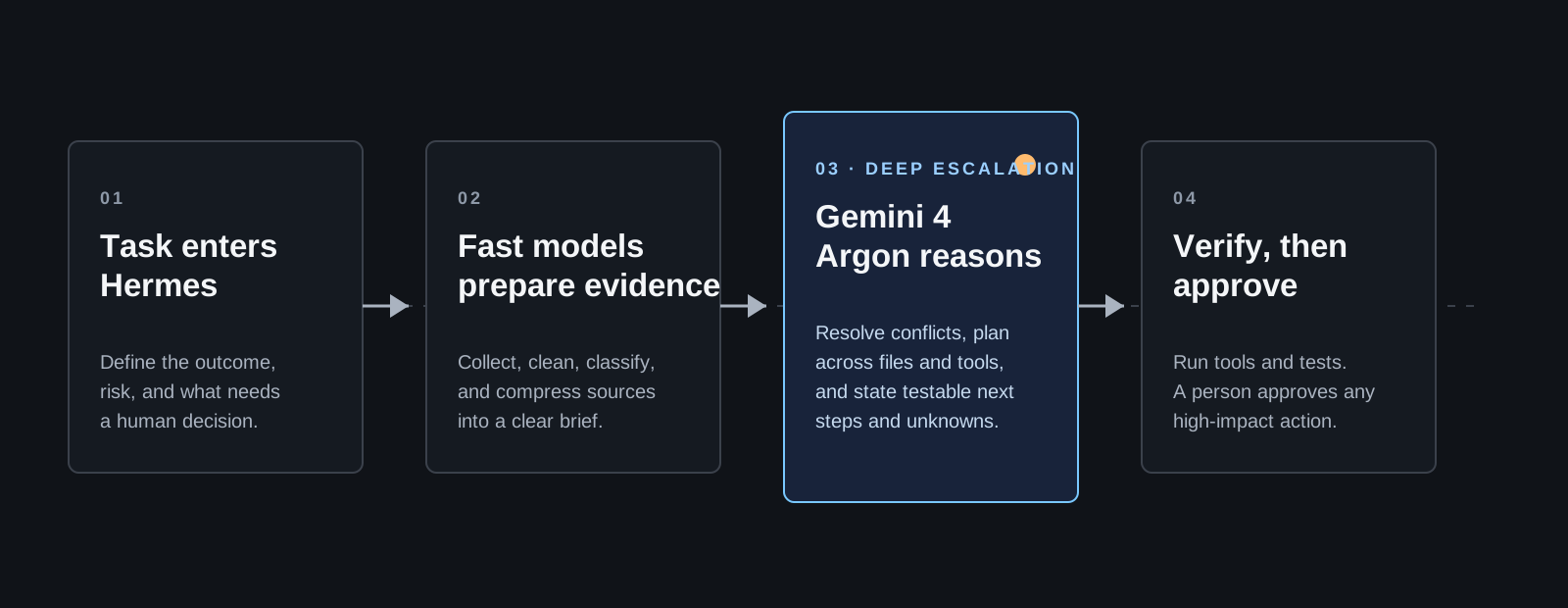
When using Argon in Hermes, state the job in plain terms: what needs to be solved, what material it may use, and what it must not change. Let cheaper models collect material, sort it, and format it. Ask Argon to continue only when the simpler models cannot answer the question or when a mistake would cause a real problem.
HERMES MODEL ROUTING
The best workflow does not use the most expensive model every time. Hermes can first use lower-cost models to collect sources, remove duplicates, and list the important points. If the sources disagree, or if changing one file may affect other parts of a project, ask Argon to work through the problem step by step. This costs less and makes the answer easier to check.
Use DeepSeek V4.1 Flash to find key facts, group similar items, and clean up source material.
DeepSeek V4.1 Flash →If you need to read audio, PDFs, video, and text together, start with Gemini 3.8 Flash.
Gemini 3.8 Flash →If the question is about a screenshot, product image, or video, start with Qwen3.7 Plus.
Qwen3.7 Plus →If the earlier steps still cannot answer the question, ask Argon to explain the cause, make a plan, and say how to check the next step.
TASK FIT
Fixing a hard bug, checking how a codebase is designed, reading a long set of materials, solving math or science questions, or jobs that need several tools in sequence.
Bulk extraction, simple grouping, routine rewriting, and the first pass of research. Start with a fast, low-cost model. Send only the difficult cases to Argon.
Payments, changes to a live site, public messages, legal conclusions, and security conclusions. Argon can prepare facts and options, but a person must make the final decision.
1M IS NOT UNLIMITED SPACE
Think of 1M tokens as one large backpack. The material you send, the model’s hidden thinking, tool results, and the final answer must all fit inside it. More source material leaves less room to think and answer. For a very long answer, use a background task. A normal request can return up to 65,536 tokens.
OFFICIAL API PRICING
Through November 30, 2026, Google lists $2 for 1M input tokens and $10 for 1M output tokens. Output pricing also includes tokens used while the model thinks. A cached input is $0.10. From December 1, those rates become $4, $20, and $0.20.
REAL CASE: IMPROVING A LARGE CODEBASE
Google published an ADK Python example with about 205,000 lines of code, nearly 800 files, and roughly 17,000 unit tests. After an 11-hour run, preparing a long task took about 40% less time and the code started about 21% faster. But the first run did not get the project rules. It changed a public data format, called JSON, and missed some unusual test cases. The second run got the rules and the full test suite first. Then it produced a change an engineer could review. The lesson is simple: do not drop a whole project into a model. First say what it must not touch and how you will check the result.
Official case. Read the full case ↗
USING THE SAME IDEA IN HERMES
This is a practical Hermes example, not a measured result from Google or Hermes. It shows what Argon should do and what it must not do by itself.
Find why the site starts more slowly after an update, then write a repair plan an engineer can check. The model must not change the live site.
Speed-test results, error logs, the list of recent changes, relevant folders, public interfaces that must stay the same, project rules, and test commands.
Fast models have found the suspicious files, but there are still several possible causes, or changing one file may affect another feature.
Merge code, change a data format, change permissions, deploy to production, and explain the problem outside the team.
Hermes first asks low-cost models to read the speed tests, error logs, and recent changes. They remove duplicates and keep only likely files, useful clues, places where sources disagree, and interfaces that must not change. Argon does not spend expensive time on basic searching.
Give Argon one clear question: compare the possible causes, explain which files affect one another, and suggest the smallest safe change. It must say why, what could go wrong, which tests to run, and what it still does not know. It may draft a change, but it must not merge it.
Hermes then runs unit tests, interface checks, startup-speed tests, and code-rule checks. A checking Agent looks only at results you can repeat: did speed improve, which tests failed, and did an interface or data format change? If the evidence is weak, ask Argon to keep working. Do not accept the first answer.
An engineer reads three things before merging: what we found, what we plan to change, and what the tests showed. Google’s example shows why this matters. Even a strong model can change the wrong thing without project rules and human review.
REAL CASE: SECURITY REVIEW
Google says Wiz used Argon to find a serious hospital-software bug that earlier models missed. Google also used it to find issues in internal and open-source software. That makes it useful for finding clues and preparing a repair plan. It does not mean the model should fix a bug, deploy a change, or disclose a bug by itself. Hermes should separate scanning, reproducing, testing, and publishing. Give the model only the permissions it needs for the current step. A person must approve changes to a live system, payments, external messages, and security conclusions.
Official safety case. Read the safety note ↗
READING A LOT OF MATERIAL
First let the Hermes Agent that finds sources remove duplicates, mark stronger sources, and show where sources disagree. Then ask Argon to compare the claims. Ask for a fixed answer: what we can trust, where the proof is, what disagrees, what we still do not know, and who checks next. This helps you trace a conclusion back to its source instead of getting one long summary that only sounds convincing.
COMMUNITY DISCUSSION: TEST IT YOURSELF BEFORE YOU SCALE
Early developer discussion often covers long context, hard code problems, thinking levels, and price. This can help you decide what to test. For example: is medium thinking enough, or does high thinking prevent enough rework to justify the cost? Other people’s reports are not a replacement for your own test. This page should label them as community observations with a date and link, not as a promise.
WHAT TO KNOW BEFORE USING THE OFFICIAL API
WHAT IT CAN AND CANNOT DO
It can read text, images, video, audio, and PDFs, then answer in text. It can also call functions, return a fixed format, run code, search, and read a web link. Computer use is still in preview. It cannot generate images, use the Live API, or use a manually set fixed context cache.
FAQ
Through November 30, 2026, 1M input tokens cost $2 and 1M output tokens cost $10. Tokens used while the model thinks count as output. The rates become $4 and $20 on December 1.
It is one shared space. The material you send, the model’s thinking, tool calls, and the final answer all use it. More material leaves less room to think and answer.
Start with Gemini 3.8 Flash to read mixed material quickly and get a first understanding. If the job needs you to consider many files at once, make a hard plan, or carefully review important code, define the task clearly and send it to Argon.
SOURCES
Capabilities, context limits, pricing, and migration requirements come from Google’s Gemini API documentation, checked on October 14, 2026.