Amazon's Chronos-Bolt Mini Runs 250x Faster With Zero Training Required
Amazon's chronos-bolt-mini is a 21M-parameter T5-based time series foundation model for zero-shot forecasting. Up to 250x faster and 20x more memory-efficient than the original Chronos at equal parameter count.
Takeaways
- Amazon's chronos-bolt-mini is a 21M-parameter T5-based time series foundation model for zero-shot forecasting.
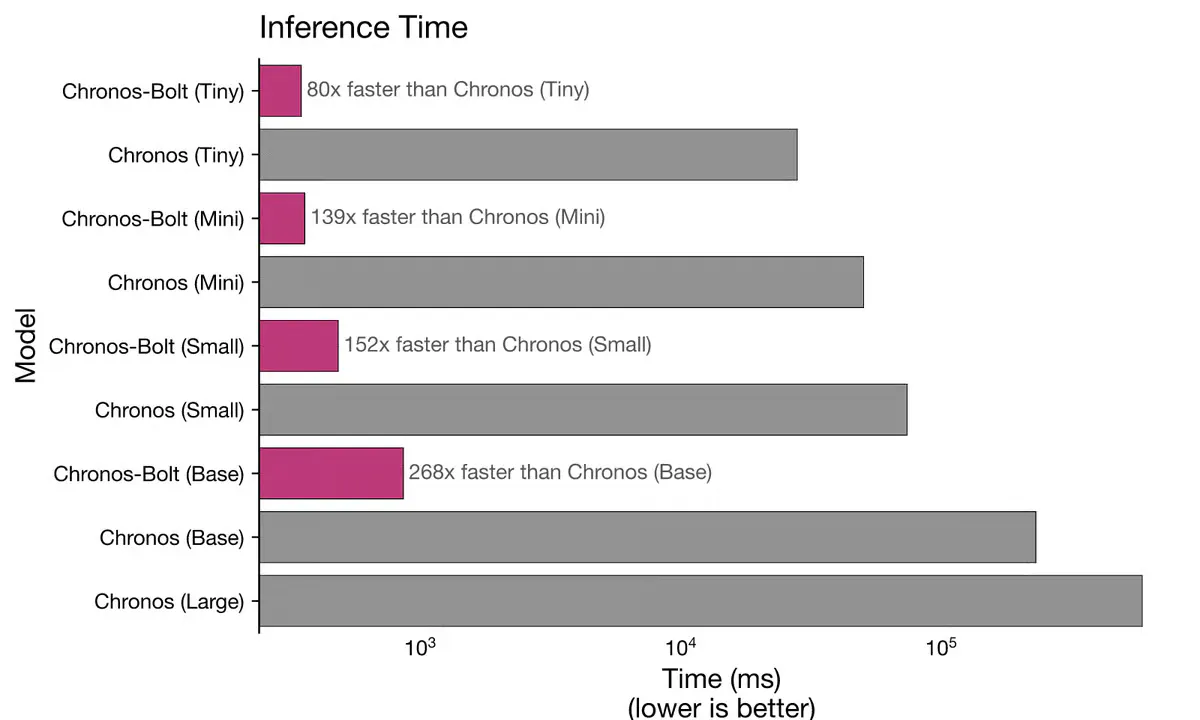
- Up to 250x faster and 20x more memory-efficient than the original Chronos at equal parameter count.
- Pretrained on nearly 100 billion time series observations spanning real and synthetic data.
- Outputs probabilistic quantile forecasts via direct multi-step decoding on patched inputs.
- Univariate only; use AutoGluon for covariates, fine-tuning, and ensembling.
- Apache-2.0 licensed, deployable on CPU, GPU, or SageMaker JumpStart .
Amazon’s Chronos-Bolt family applies pretrained foundation models to time-series forecasting. The Bolt Mini checkpoint has 21 million parameters, uses a T5-efficient encoder-decoder backbone, and has recorded more than one million downloads on Hugging Face.
At inference, a developer supplies an ordered numeric history and a forecast horizon. The model returns probabilistic forecasts without per-series training, feature construction, or hyperparameter searches. That makes Bolt Mini useful as a shared zero-shot baseline across large collections of series, though production deployments still require frequency alignment, backtesting, calibration checks, and monitoring.
Patches cut the decoding loop
The original Chronos converts scaled observations into discrete tokens and predicts future tokens autoregressively with cross-entropy loss. Chronos-Bolt instead divides the historical context into patches containing several observations, passes those patches through the encoder, and predicts quantiles for the full horizon in one decoding pass.
Patch encoding shortens the input sequence, while direct multi-step output removes the token-by-token generation loop. Amazon reports that Bolt models run up to 250 times faster and use up to 20 times less memory than equivalent original Chronos models. In the authors’ benchmark, Chronos-Bolt Base also exceeded Chronos Large’s forecast accuracy while running more than 600 times faster. Hardware, batch size, context length, and forecast horizon affect those ratios, so deployment benchmarks should use the intended workload.
Training targets quantiles
Chronos-Bolt uses Google’s T5-efficient architecture, derived from the encoder-decoder design documented in the
Reporting is indexed from AlphaSignal. Rights remain with the original publisher and cited sources.
Read original report