Anthropic's Claude Fable 5.2 Tops Robot Arm Benchmark With 29-Point Leap
Claude Fable 5.2 leads AA-Robotics v0.1 with a score of 75, ahead of GPT-6 Astra (69) and GPT-6.1 Sol (65). First model ever to score on the measure-box task, estimating dimensions from video alone. Used a tape measure left in the scene as a visual scale rather than manipulating it.

Takeaways
- Claude Fable 5.2 leads AA-Robotics v0.1 with a score of 75, ahead of GPT-6 Astra (69) and GPT-6.1 Sol (65).
- First model ever to score on the measure-box task, estimating dimensions from video alone.
- Used a tape measure left in the scene as a visual scale rather than manipulating it.
- Jumped 29 points over Fable 5.1, which had trailed the leaderboard at 46.
- Benchmark uses a Hiwonder NexArm 6-axis arm controlled via Python and HTTP across 8 tabletop tasks.
- Top models are still roughly 100x slower and 10x more expensive than humans per task.
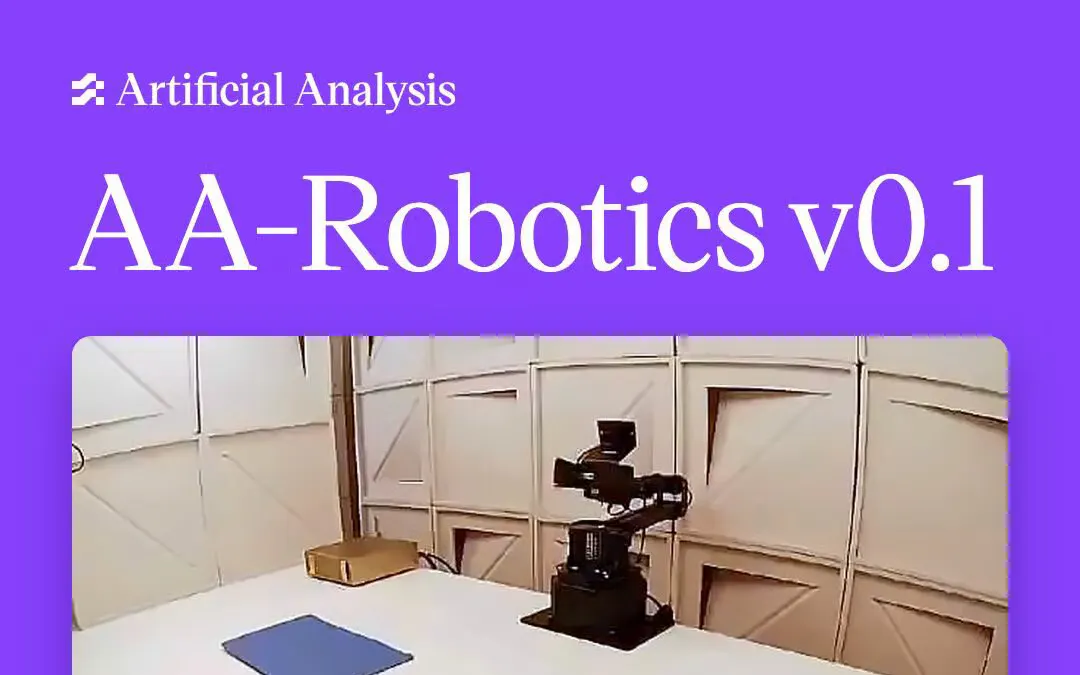
Anthropic’s Claude Fable 5.2 has taken first place on AA-Robotics v0.1, a benchmark that lets language models control a physical robot arm through code. Claude Fable 5.2 scored 75, ahead of GPT-6 Astra at 69 and GPT-6.1 Sol at 65. Its score improved by 29 points over Fable 5.1, which scored 46.
Fable 5.2 also became the first reported model to complete the benchmark’s measure-box challenge. Its solution used the tape measure’s printed markings as a visual scale, allowing the model to estimate the box’s dimensions from camera images without performing the more difficult manipulation of measuring each side physically.
A tape measure becomes a visual ruler
AA-Robotics asks models to measure a box’s length, width, and height, with each estimate required to fall within 2 mm of the correct value. At the benchmark’s October launch, no model completed the task. GPT-6 Astra scored zero, and GPT-6.1 Sol and Claude Opus 5.5 each received partial scores of 17 out of 100.
Fable 5.2 kept the tape measure in the camera frame and interpreted its markings as a reference scale. The approach converted a demanding motor-control task into a visual-reasoning problem, showing that a general-purpose model can choose a simpler route when the robot’s dexterity becomes a bottleneck.
Eight tasks, one robot arm
Artificial Analysis describes AA-Robotics v0.1 as a research preview for evaluating how frontier models perceive, plan, and act in a physical environment. A coding-agent framework provides camera images and lets each model run Python and send HTTP commands to a Hiwonder NexArm, a six-axis arm with five joints and a gripper.
Models receive brief instructions covering the arm, its interface, and task completion. They receive no task-specific demonstrations, making the evaluation zero-shot: each model must infer a strategy, inspect the resulting camera images, and adjust its commands during the attempt.
- Control and dexterity: grasping, moving, and handling objects precisely.
- Spatial reasoning: estimating positions and understanding how objects interact.
- Adaptability: revising a plan when the environment or an action produces an unexpected result.
The eight tabletop scenarios include placing a toy crocodile, pouring a drink, tidying a box, matching shapes, building a tower, and measuring a box.
One release redraws the ranking
Current results place Fable 5.2 six points above the previous leader. The table preserves the more precise launch scores published in October.
| Model | Latest score | October launch score |
|---|---|---|
| Claude Fable 5.2 | 75 | Not tested |
| GPT-6 Astra | 69 | 69.4 |
| GPT-6.1 Sol | 65 | 64.6 |
| Gemini 4 Argon | 55 | 55.3 |
| Claude Opus 5.5 | 49 | 48.8 |
| Claude Fable 5.1 | 46 | 46.3 |
Fable 5.2’s robotics gain accompanies strong results on Artificial Analysis’s broader intelligence index . It leads that ranking at 64.6%, followed by Gemini 4 Carbon at 60.0% and Claude Opus 5.5 at 59.1%.
Thirty minutes for a tabletop task
Benchmark-leading performance remains too slow and costly for routine deployment. Artificial Analysis reports that the strongest models take about 30 minutes per task, making them roughly 100 times slower and 10 times more expensive than a person performing the same work.
Published launch costs also varied sharply. GPT-6.1 Sol cost $1.93 per task at a score of 65. GPT-6 Astra cost $16.36 per task at a score of 69. Claude Opus 5.5 and Claude Fable 5.1 both cost more than Sol and produced lower scores. Artificial Analysis has not published a per-task cost for Fable 5.2’s new run.
What developers can take from the result
- Camera input can support measurement. Fable 5.2 used visible tape markings as a scale instead of treating the image solely as a scene description.
- Planning can compensate for limited hardware. The model avoided a difficult manipulation sequence by selecting a vision-based method.
- General instructions can produce novel strategies. The model completed the task without a worked example or task-specific training demonstration.
For developers building agents around cameras, sensors, or actuators, the result shows how a coding model can combine perception, tool use, and control through a simple API. The same pattern can support systems that inspect an environment, choose among available tools, execute commands, and revise a plan from new observations.
AA-Robotics remains a small research benchmark built around eight tabletop tasks and one robot arm. Its scores do not establish industrial reliability, safe operation, or economic viability. They do show that model upgrades can produce large gains in physical problem-solving without changing the surrounding hardware or control framework.
Reporting is indexed from AlphaSignal. Rights remain with the original publisher and cited sources.
Read original report