Google DeepMind's Gemini 4 Carbon Tops LM Arena's Text Leaderboard at 72% Less
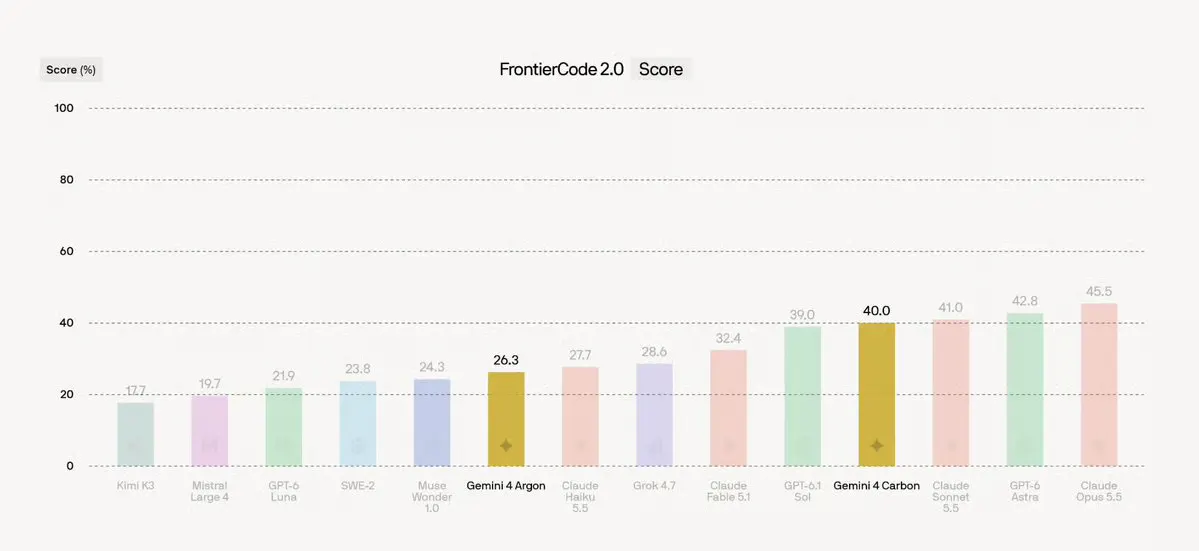
Gemini 4 Carbon (High) debuts #1 Text, #2 Agent, #4 WebDev on Arena. Carbon costs $1.80 per task, 72% cheaper than Claude Opus 5.5 at the top. GPT-6.1 Terra (Max) hits Agent Arena #8 at just $0.62 median cost per task. MAI-Image-2.7-Preview jumps to #3 in Single Image Edit, +45 pts over v2.6.

Takeaways
- Gemini 4 Carbon (High) debuts #1 Text, #2 Agent, #4 WebDev on Arena.
- Carbon costs $1.80 per task, 72% cheaper than Claude Opus 5.5 at the top.
- GPT-6.1 Terra (Max) hits Agent Arena #8 at just $0.62 median cost per task.
- MAI-Image-2.7-Preview jumps to #3 in Single Image Edit, +45 pts over v2.6.
- Connectors in Agent Mode add GitHub, Vercel, Linear, Supabase, Notion, Gmail.
- Carbon trade-off: 2.3x more reasoning tokens and much longer task runtimes.
Arena, which ranks models using community interactions, put Google DeepMind’s Gemini 4 Carbon at No. 1 in Text Arena, No. 2 in Agent Arena, and No. 4 in Code Arena: WebDev. The weekly update also introduced a lower-cost OpenAI agent model, advanced Microsoft’s image editor, and added external service connectors to Agent Mode. Developers now have more price-performance options and can run tool-connected tasks within Arena.
Carbon pairs high ranks with longer runs
According to the Carbon announcement , Gemini 4 Carbon (High) scored 1,528 points in Text Arena, eight points above Gemini 4 Argon (High). Its Agent Arena ranking reflects more than 21,900 real-world agent sessions and places it ahead of GPT-6 Astra and Fable-5.1. Claude Opus 5.5 (Max) retained the No. 1 agent position.
Arena reports a median cost of $1.80 per task for Carbon, 72% below Opus 5.5. That combination of rank and cost extends the Pareto frontier, the set of options for which no alternative is both higher-scoring and cheaper. The figures are benchmark-specific medians, so task length, tool use, token volume, and provider billing can produce different costs in production.
Arena’s steerability signal measures how well a model adjusts after corrective feedback. Carbon ranked first on that measure, with the leaderboard reporting a gain of 18.6%. Stronger steerability can reduce correction turns when an agent drifts from its instructions.
Independent benchmark results expose Carbon’s operational costs. Finance and Tax Agent tasks took more than twice as long as they did with Argon, and Legal Research tasks averaged more than 50 minutes. Carbon also generated 2.3 times as many reasoning tokens, the internal computation tokens used before producing an answer. That volume can increase response times and metered usage, making Argon a candidate for latency-sensitive workloads.
Terra cuts the agent bill
OpenAI’s GPT-6.1 Terra (Max) entered Agent Arena at No. 8 with a reported 10.6% net improvement and a median cost of $0.62 per task. Terra costs roughly one-third as much as Carbon and less than one-tenth as much as Opus 5.5 under Arena’s evaluation. Its position on the quality-cost frontier makes it a candidate for high-volume workflows whose tasks can tolerate lower-ranked model performance.
Microsoft’s editor gains 45 points
Microsoft AI’s MAI-Image-2.7-Preview debuted at No. 3 in the Single Image Edit Arena, 45 points above version 2.6 at No. 6. Elo-style scores track relative preference outcomes, and a 45-point increase has no direct percentage interpretation. The movement indicates that version 2.7 won materially more favorable comparisons within Arena’s evaluation pool.
Connectors let Agent Mode act
Arena also added Agent Mode connectors for Vercel, Linear, GitHub, Supabase, Notion, Gmail, Google Drive, and Google Calendar. A single task can now gather context and take actions across code repositories, deployment platforms, project trackers, documents, email, and calendars.
Connect a service in three steps
- Select a connector below the Agent Mode input box.
- Complete the service provider’s OAuth authorization flow.
- Enable the connector for turns that require access, then disable it for other turns.
The per-turn toggle limits when an agent can invoke a connected service. OAuth scope review, least-privilege accounts, and service-level revocation remain separate controls. Teams handling sensitive repositories or communications can pair those controls with human approval for consequential actions.
GitHub’s connector supports repository and branch selection. After receiving a prompt, the agent can read the codebase, edit files, and run commands. A dedicated diff view shows syntax-highlighted changes for either the latest turn or the full branch, allowing developers to inspect modifications before pushing them through the normal review process.
Where each option fits
| Workload | Candidate | Reported advantage | Constraint to test |
|---|---|---|---|
| Text and high-end agent tasks | Gemini 4 Carbon | No. 1 in Text Arena and No. 2 in Agent Arena | Latency, verbosity, and reasoning-token volume |
| Highest Arena agent rank | Claude Opus 5.5 | No. 1 in Agent Arena | Higher median task cost |
| High-volume agent workloads | GPT-6.1 Terra | $0.62 median cost per task | No. 8 Agent Arena rank |
| Latency-sensitive reasoning | Gemini 4 Argon | Faster completion in the cited tests | Task-specific quality compared with Carbon |
| Single-image editing | MAI-Image-2.7-Preview | No. 3 rank and a 45-point gain | Performance on the team’s own asset types |
| Tool-connected tasks | Arena Agent Mode | OAuth connectors with per-turn controls | Permission scope, action review, and audit requirements |
Arena’s median costs apply to tasks in its evaluation and can differ from production workloads. Weekly ranks can also move as more sessions accumulate, especially when score gaps are small. Deployment evaluations should replay representative tasks and measure completion rate, wall-clock latency, token use, tool-call accuracy, and end-to-end cost.
Reporting is indexed from AlphaSignal. Rights remain with the original publisher and cited sources.
Read original reportSources
- 01x.com
- 02x.com
- 03the-decoder.com
- 04x.com
- 05arena.ai
Next reads

Artificial Analysis' AA-Omniscience v1.1 Catches AI Models Guessing Instead of Abstaining

Artificial Analysis Adds HLE-Diamond and Gemini 4 Carbon Tops at 69%