Liquid AI's LFM3 Packs Six Multimodal Models Into a 1.7B Open-Weight Family
Liquid AI released LFM3 , six open-weight ~2B models sharing one tri-hybrid backbone. Lineup covers text, vision+video, audio, omni, and typed-output decision models ( d1-Omni-2B ). Tri-hybrid: 13 gated short convs, 5 sliding-window attention, 6 global attention layers across 24 layers.

Takeaways
- Liquid AI released LFM3 , six open-weight ~2B models sharing one tri-hybrid backbone.
- Lineup covers text, vision+video, audio, omni, and typed-output decision models ( d1-Omni-2B ).
- Tri-hybrid: 13 gated short convs, 5 sliding-window attention, 6 global attention layers across 24 layers.
- LFM3-VL-2B averages 71.4 across 62 vision benchmarks, matching Gemma 4 12B at a sixth the size.
- Text model fits in ~1 GB at 4-bit with 256K context; KV cache ~1.6 GB at 128K.
- d1 decision models return calibrated typed answers in one forward pass, 5.8 ms per decision on H100.
Liquid AI has released LFM3, a family of six open-weight models built from the same 1.7-billion-parameter backbone. The variants cover text, vision, audio, combined multimodal input, and structured decision tasks. They target phones, laptops, edge servers, and other memory-constrained hardware.
Liquid trained the base model on 22 trillion tokens and says each variant can be fine-tuned on a single GPU. Developers can get the weights under the LFM Open License v1.0. Teams should review that license before distributing derivatives or deploying commercial services.
Six models from one compact core
Each model adapts the shared backbone to a specific modality or output format. Additional encoders and task-specific components bring several variants to roughly 2 billion parameters.
| Model | Inputs and outputs | Primary use |
|---|---|---|
| LFM3-1.7B | Text input and output, 256K context | Local assistants and long-running agents |
| LFM3-VL-2B | Images, video, and text | Visual reasoning and spatial grounding |
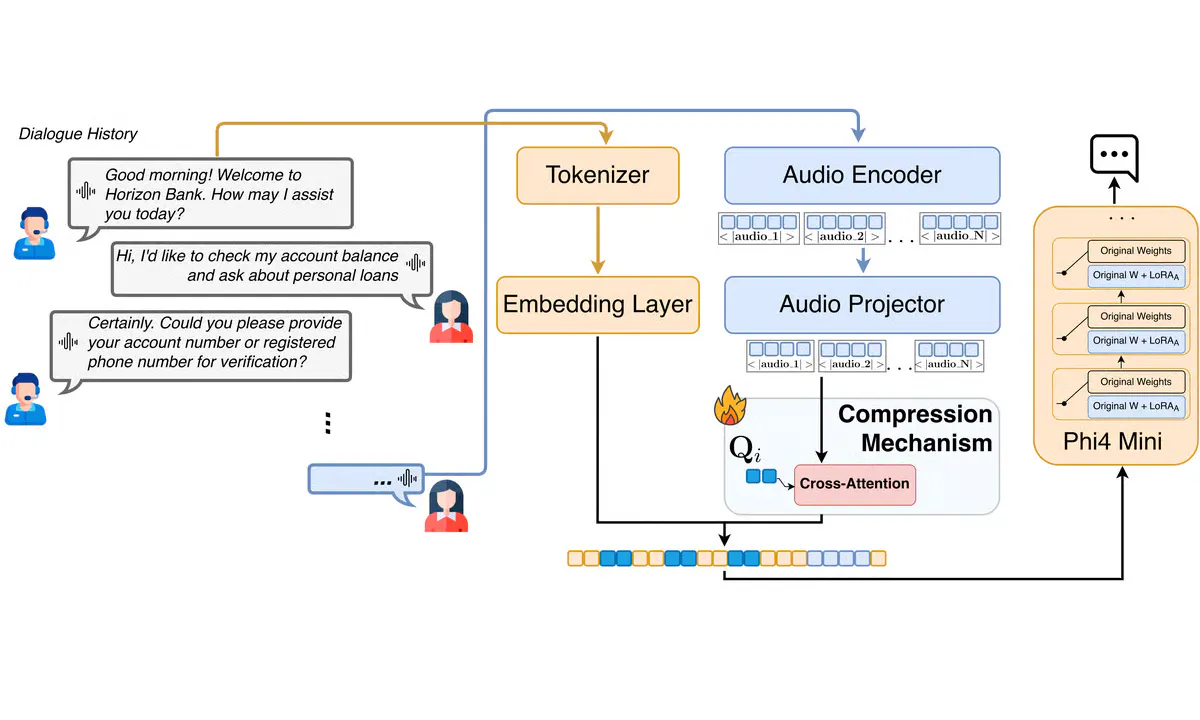
| LFM3-Audio-2B | Speech, text, and tool calls in 18 languages | Voice interfaces and spoken automation |
| LFM3-Omni-2B | Vision, audio, and language | Multimodal reasoning |
| d1-2B | Text or JSON with typed outputs | Classification, routing, scoring, and extraction |
| d1-Omni-2B | Text, JSON, images, or audio with typed outputs | Multimodal decision pipelines |
Liquid’s LFM3 overview describes the family as a set of specialized branches from the common base. Deployments still load the selected variant’s weights; the shared lineage does not imply that several models automatically share memory at runtime.
How LFM3 spends its memory
LFM3 divides its 24 layers among three mechanisms: 13 gated short-convolution layers, five sliding-window attention layers, and six global-attention layers. The short convolutions process nearby token patterns without a key-value cache. Sliding-window attention retains a bounded 256-token cache, while global attention preserves access to the full sequence.
This tri-hybrid layout limits the memory consumed by the key-value cache, which stores representations of earlier tokens during generation. Liquid reports that LFM3-1.7B uses about 1.6 GB of cache at 128K tokens, compared with 4.3 GB for Qwen3.5-4B. The text model’s quantized weights occupy roughly 1 GB at 4-bit precision.
Those figures make long-context local inference more practical, although total memory also includes activations, runtime workspaces, application state, and framework overhead. Cache size alone does not establish prompt-processing speed, particularly when an application fills a large portion of the 256K-token window.
Reporting is indexed from AlphaSignal. Rights remain with the original publisher and cited sources.
Read original report