SwarmCoDe Lets 50 Robot Designs Autonomously Specialize Into 200-Agent Fleets
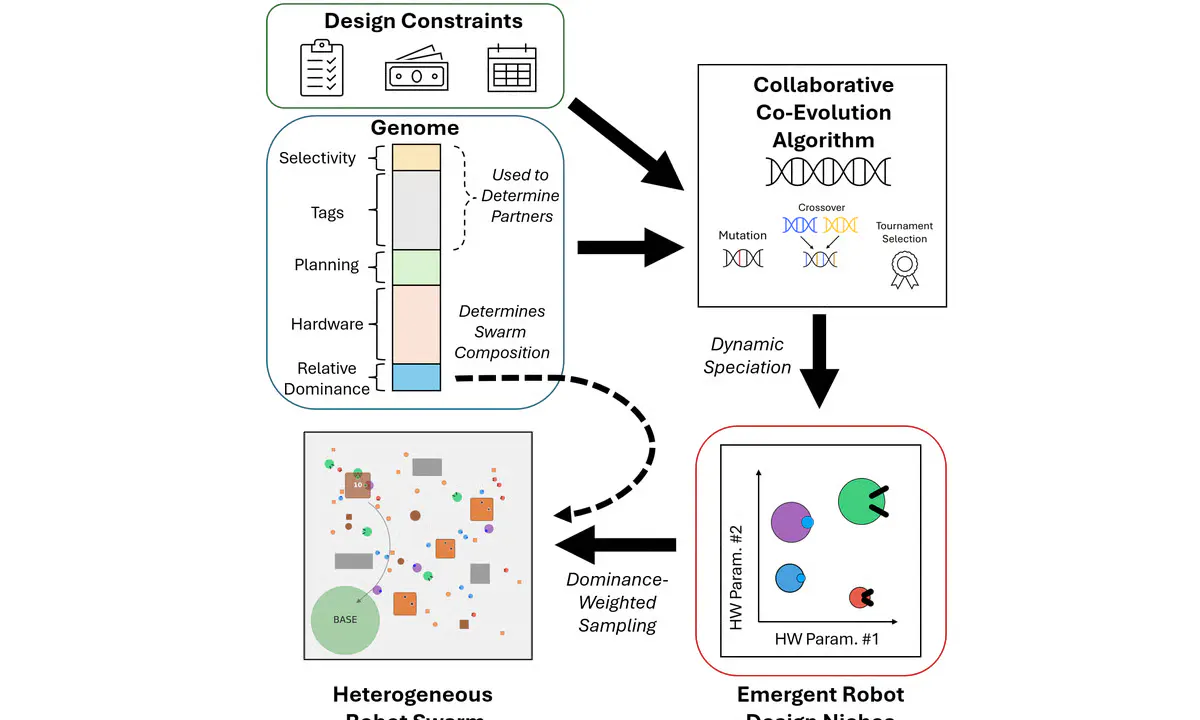
SwarmCoDe is a co-evolutionary algorithm for jointly designing robot morphology and behavior in heterogeneous swarms. Dynamic speciation via evolved genetic tags removes the need to pre-specify the number of robot species.
Takeaways
- SwarmCoDe is a co-evolutionary algorithm for jointly designing robot morphology and behavior in heterogeneous swarms.
- Dynamic speciation via evolved genetic tags removes the need to pre-specify the number of robot species.
- A dominance gene decouples deployed swarm size from evolutionary population size, enabling 4x scaling.
- Evolved swarms matched task structure: 1, 2, and 4 species for 1-, 2-, and 4-niche delivery tasks.
- Beats fixed-K CCEA baselines and adapts when task requirements change mid-run.
- Scales to 200-agent deployed swarms from a 50-individual evolutionary population under fabrication budgets.
Andrew Wilhelm and Josie Hughes propose SwarmCoDe , a coevolutionary framework that jointly optimizes robot designs, cooperation signals, and deployment ratios. The method allows a swarm’s specialization structure to emerge from task performance. In package-delivery benchmarks, it discovered task-dependent roles, adapted when requirements changed, and produced deployments of up to 200 robots from an evolutionary population of 50 candidates.
Fixed species counts create a blind spot
Robot co-design searches hardware variables, such as morphology, sensors, and actuators, alongside control and task-planning strategies. Small gains in unit performance or fabrication cost can compound across a large fleet, but each possible role, component, and team ratio expands the search space.
Classical Collaborative Co-Evolutionary Algorithms divide candidate designs into K subpopulations that evolve together. The designer must choose K in advance, effectively guessing how many specialist types the task requires. Wilhelm and Hughes report that the best value changes with the task, while values above or below the underlying number of functional niches reduce performance.
Signals let specializations emerge
SwarmCoDe removes the fixed species count by giving every candidate design three additional evolvable properties:
| Evolved property | Function |
|---|---|
| Genetic tags | Provide signals that other candidates can use to assess compatibility. |
Reporting is indexed from AlphaSignal. Rights remain with the original publisher and cited sources.
Read original report