
ZazenCodes' Claude Code Software Factory Hits 500 GitHub Stars
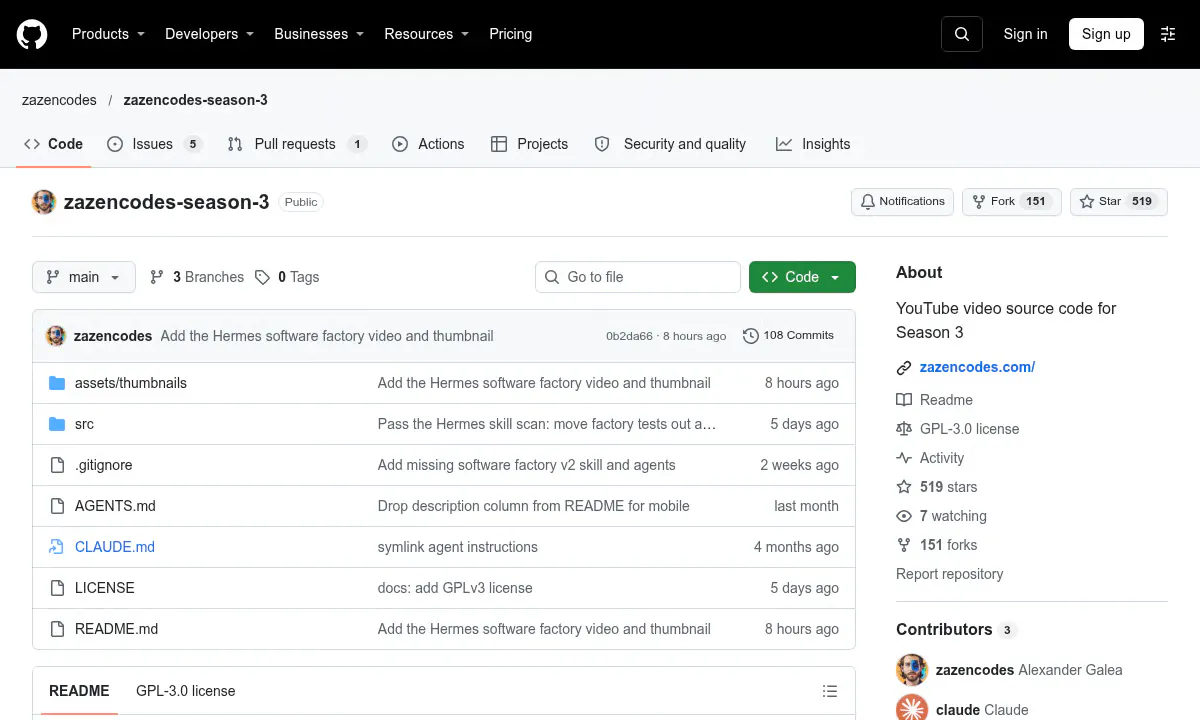
zazencodes-season-3 is trending on GitHub, with 500+ stars and 150 forks, driven by its agent software-factory templates. The factory turns factory -labeled GitHub issues into PRs: intake, spec, build, gate, review, approve.
Takeaways
- zazencodes-season-3 is trending on GitHub, with 500+ stars and 150 forks, driven by its agent software-factory templates.
- The factory turns
factory-labeled GitHub issues into PRs: intake, spec, build, gate, review, approve. - v2 adds GitHub issue/PR integration, a scripted pre-review gate, parallelism, and Haiku-powered reviews.
- The factory never merges: a human merges each PR, which closes the linked issue.
- It's free under GPL-3.0; one user reported the v2 agent files were missing from the repo.
- A Hermes Agent version now sits next to the Claude Code factories in
src/.
A companion repository for the third season of ZazenCodes videos has reached GitHub’s Trending list. At publication, the season three repository had more than 500 stars and 150 forks, including 125 stars added during the previous week. Most of the activity centers on a do-it-yourself software factory built with Claude Code and later adapted through a Hermes Agent port .
The workflow turns labeled GitHub issues into reviewed pull requests. Claude Code, Anthropic’s terminal-based coding agent, coordinates specialized agents while shell scripts run tests and linting. A human retains the final merge decision, making the project a compact reference for teams exploring agent-driven development without deploying a separate orchestration platform.
One repository, several agent experiments
Most directories correspond to a video and contain prompts, configuration files, scripts, or example code. The video index covers several experiments:
- Developer tooling: a Kanban board built with Claude Code hooks .
- Research automation: a literature-review skill connected to Consensus MCP . MCP, or Model Context Protocol, gives an agent a standard interface for calling external tools and data sources.
- Skill portability: porting notes for Claude Code, Codex, Cursor, Copilot, and Antigravity.
- Local inference: a local-model guide using Ollama and llama.cpp on an M4 MacBook Pro.
Four directories in the source tree contain the factory implementations: software-factory-claude-code , software-factory-claude-code-v2 , hermes-software-factory , and hermes-hostinger-webui-memory . Downstream installations and experiments largely draw from this group.
From issue label to pull request
The creator connects the project to the software-factory concept developed in the late 1960s: structured requests enter a repeatable production process and emerge as code changes. In the creator’s account , GitHub issues supply those requests, agents write specifications and implementations, automated checks reject broken builds, and reviewers inspect the surviving changes.
The initial Claude Code implementation uses seven role definitions under .claude/agents/ and a coordinating skill at .claude/skills/factory/SKILL.md , according to a community breakdown . Agent definitions are Markdown files containing role-specific instructions, while the skill describes the sequence and handoffs. The
Reporting is indexed from AlphaSignal. Rights remain with the original publisher and cited sources.
Read original report

