
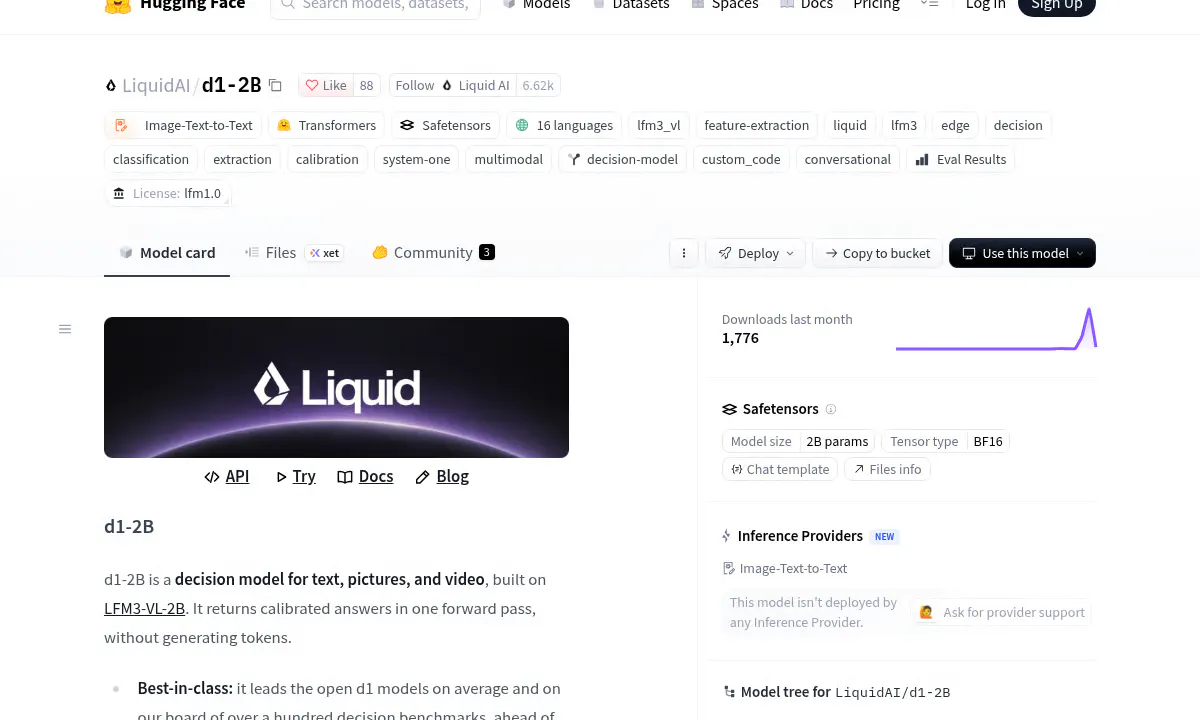
Liquid AI's LFM3 Beats 9B Rivals Using a Tiny 1.7B On-Device Model
Liquid AI launched LFM3, a tri-hybrid family of six open-weight 2B models spanning text, vision, audio, omni, and decision tasks, all fine-tunable on a single GPU.
A focused feed of models, agents, research and open-source releases for people building with AI.
Liquid AI launched LFM3, a tri-hybrid family of six open-weight 2B models spanning text, vision, audio, omni, and decision tasks, all fine-tunable on a single GPU.

PhysAg3D generates physically interactive 3D assets from a single image, with joints and soft bodies ready for simulation Pairs a frozen image-to-3D mesh generator with a vision-language agent that reasons about parts and interactions Hierarchical representation links interaction intent to joints

Balestriero and LeCun prove JEPAs trained on different modalities converge up to one rotation given good views . Next-token prediction is reframed as a JEPA with bad views, explaining why LLMs align with vision only through scale.

A classic Wide-ResNet-50-2 backbone retrained with the RACM recipe is quietly pulling 850K+ monthly downloads on Hugging Face for image classification work.

Liquid AI's LFM3 family puts six specialized 2B models on one tri-hybrid backbone, with vision, audio, and decision variants that fine-tune on a single GPU.

A new survey reframes foundation model adaptation for medical imaging as a risk-control problem, mapping five mechanisms to clinical deployment trade-offs.

Baidu's 3B open-source vision-language model parses hundred-page documents in a single request using a sparse attention trick that keeps memory flat.

Microsoft's flagship text-to-image models exit preview on Foundry, offering a quality tier near GPT-Image-2 and a Flash variant tuned for high-volume pipelines.

Microsoft AI's newest image editing model climbs to #2 on the Artificial Analysis leaderboard, trailing only OpenAI's GPT Image 2.5 Sunburst and leading four categories.

A new training recipe cuts hallucinations in multimodal reasoning models by trimming redundant thinking tokens and contrasting against deliberately induced errors.

Baidu's open-source Unlimited OCR 2 parses hundred-page documents in a single pass using a new sparse attention trick that caps memory growth.

Qwen's compact vision-language model gets a 4-bit AWQ build, cutting memory to run multimodal reasoning, OCR, and agent tasks on modest GPUs.

A community photorealism checkpoint built on SDXL crosses 859k downloads, delivering lifelike portraits and scenes without a custom pipeline.
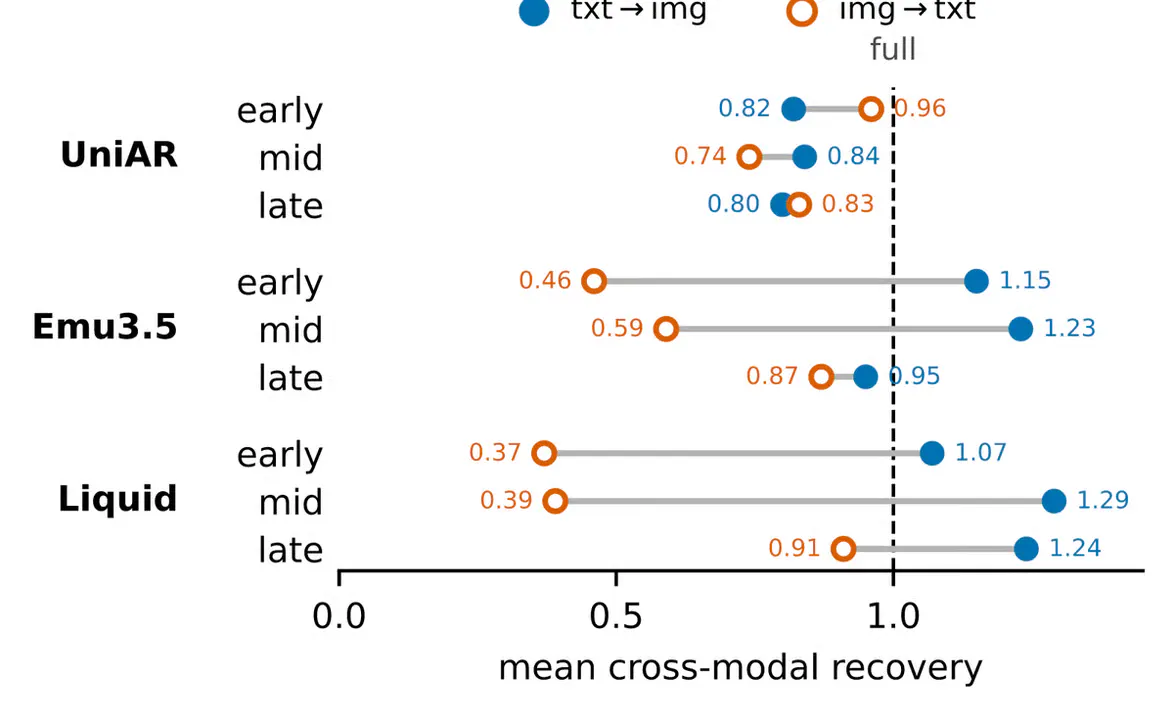
A new preprint shows that steering vectors extracted from text can control image generation and vice versa inside unified multimodal models, zero-shot.

Black Forest Labs' smallest Flux.2 model lands in ComfyUI as a single 7.75GB file, generating images in under a second on an RTX 3090.

Comfy-Org bundles FLUX.1-dev and its control variants into single-file safetensors with built-in text encoders, cutting setup friction for ComfyUI users under 24GB VRAM.

Black Forest Labs' 32B open-weight image model lands in ComfyUI with FP8 weights, a 24B Mistral text encoder, and 10-image multi-reference editing.

Comfy-Org's drop-in bundle of repackaged Qwen-Image-Edit checkpoints for ComfyUI crossed 1.68M downloads, now covering the 2511 refresh and five LoRAs.

Comfy-Org has published a repackaged archive of Stable Diffusion v1.5 on Hugging Face, preserving the original weights after RunwayML pulled its page.

A new training objective called MCLR reproduces classifier-free guidance effects at training time, revealing CFG as implicit contrastive alignment.
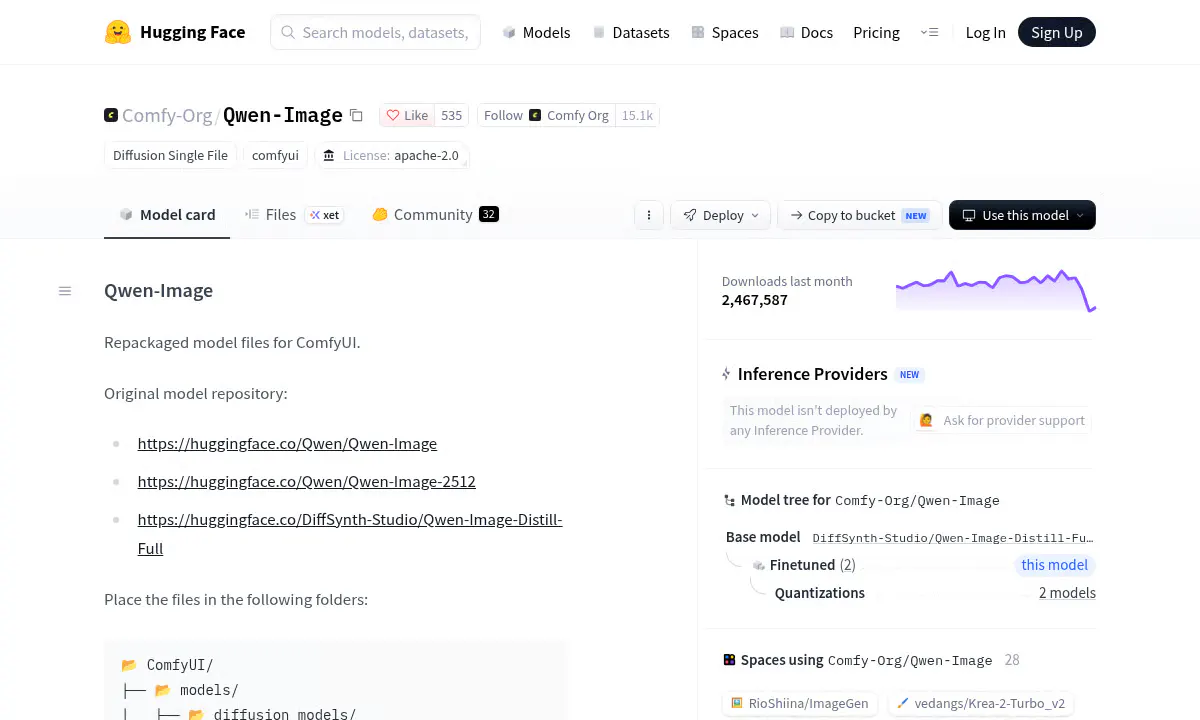
Comfy-Org maintains drop-in single-file safetensors for Alibaba's Qwen-Image family, bundling the base model, the 2512 refresh, and a distilled variant for ComfyUI.

Black Forest Labs drops a 5.6B open-weights image model that runs on 8GB VRAM, tops open benchmarks, and generates 1MP images in 4 seconds.

Alibaba's Tongyi-MAI lab released a 6B text-to-image model that renders photorealistic images in under a second on a 16GB GPU, with Apache 2.0 weights.

A self-supervised method treats multiple X-ray projections of the same patient as paired data, beating supervised and vision-language baselines on three datasets.
No stories match these filters.